Apple: The Trust vs Excitement Gap
Apple remains one of the most successful companies in history.
Its products continue to sell in enormous numbers. Its ecosystem remains one of the strongest in technology. Its customers remain among the most loyal in the world.
Yet analysis of conversations across Reddit, YouTube comments, forums, social media discussions and technology communities reveals a fascinating pattern.
The dominant conversation surrounding Apple is not anger.
It is not disappointment.
It is not rejection.
It is boredom.
People still trust Apple.
They simply appear less excited by Apple than they once were.
This distinction matters because declining trust and declining excitement create very different challenges.
Community conversations suggest Apple’s biggest challenge may not be technological.
It may be emotional.
Key Finding #1: Trust Remains Extremely High
Very few community conversations question the quality of Apple products.
Customers consistently describe Apple products as:
- Reliable
- Well designed
- Easy to use
- Long-lasting
- Seamlessly integrated
Many users continue to recommend Apple products to friends and family.
This creates an important distinction.
The issue being discussed is not whether Apple products are good.
The issue being discussed is whether they still feel exciting.
This highlights a recurring gap between traditional customer satisfaction metrics and community sentiment.
Related Framework: Customer Insight Triangle
Key Finding #2: Community Conversations Reveal A Hidden Emotional Shift
If Apple asked customers whether they were satisfied, many would likely answer yes.
Their devices work.
The ecosystem works.
The experience remains strong.
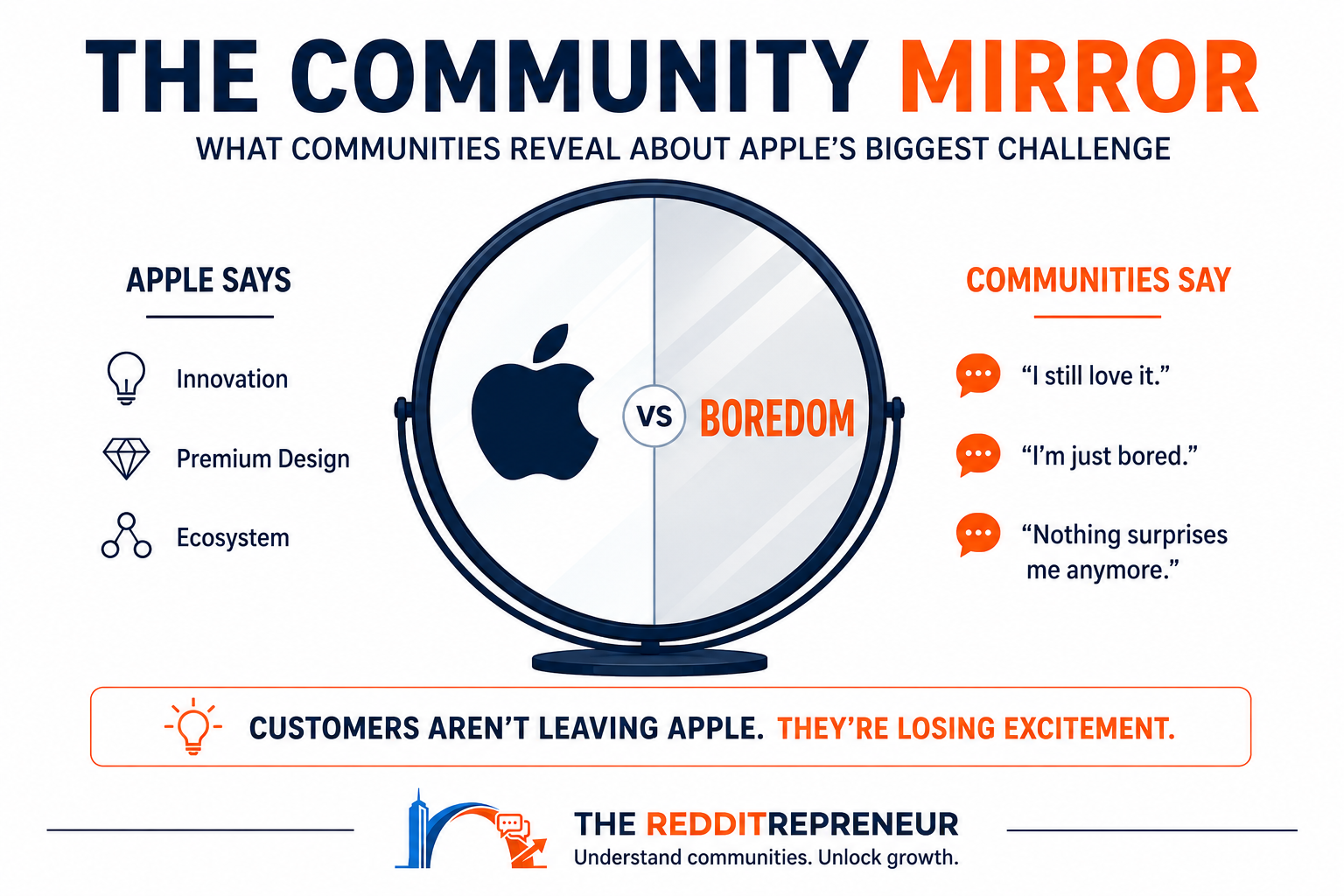
Yet beneath this surface layer, community conversations reveal recurring phrases such as:
“It feels like the same phone.”
“Nothing surprises me anymore.”
“I’ll upgrade eventually.”
“Apple has become predictable.”
These are not complaints about functionality.
They are observations about emotion.
Community discussions suggest many customers still trust Apple while simultaneously feeling less inspired by it.
Related Framework: Hidden Layer Analysis
Key Finding #3: Apple Is Competing Against Its Own History
Most technology companies compete against competitors.
Apple competes against itself.
When consumers evaluate a new iPhone, they are rarely comparing it solely against Samsung or Google.
Instead, they compare it against:
- The original iPhone
- The App Store launch
- The introduction of the iPad
- The launch of Apple Watch
- Years of category defining innovation
This creates a unique challenge.
Even genuinely strong product releases can feel underwhelming when compared against some of the most influential product launches in modern history.
Community conversations frequently reveal this dynamic.
Customers are not simply evaluating the latest Apple announcement.
They are evaluating it against decades of expectation.
Related Framework: Comparison Engine
Key Finding #4: AI Has Created Competing Narratives
Apple’s recent AI announcements provide an excellent example of how community narratives form.
Supporters interpret Apple’s cautious approach as evidence of thoughtful product development.
Critics interpret the same behaviour as evidence that Apple is falling behind.
The event remains identical.
The interpretation changes.
This explains why discussions around Apple AI often become less about the technology itself and more about competing beliefs regarding Apple’s future.
Communities are not simply evaluating features.
They are evaluating what those features mean.
Related Framework: Interpretation Gap
Key Finding #5: Familiarity Has Reduced Perceived Innovation
One recurring pattern across community discussions is that many Apple innovations no longer feel innovative.
Features such as:
- Face ID
- AirDrop
- Apple Pay
- Device syncing
- Ecosystem integration
still provide enormous value.
However, they have become normal.
What once felt remarkable now feels expected.
This creates a difficult challenge for Apple.
The more successful a company becomes at integrating innovation into everyday life, the harder it becomes for customers to recognise that innovation.
Many conversations that describe Apple as “less innovative” may actually be describing the effects of familiarity rather than a genuine absence of innovation.
Related Framework: Familiarity Illusion
Key Finding #6: Communities Are Reinforcing The Same Narrative
Communities often function as amplification systems.
One recurring belief appears repeatedly across technology discussions:
“Apple isn’t exciting anymore.”
Whether this statement is objectively true becomes less important than the fact it is repeatedly reinforced.
As more people encounter the narrative, more people begin discussing the narrative.
Over time the conversation itself gains momentum.
Community discussions increasingly shape perception through repetition rather than through direct experience.
Related Framework: Community Mirror
Key Finding #7: Apple’s Identity Is Evolving
For many years Apple represented:
- Innovation
- Creativity
- Design
- Status
- Simplicity
Today community conversations increasingly associate Apple with:
- Reliability
- Stability
- Consistency
- Trust
These are not negative attributes.
In fact, they represent many of Apple’s greatest strengths.
However, they signal an important shift.
Communities appear to be viewing Apple less as a disruptive challenger and more as an established institution.
That transition changes expectations.
Customers expect innovators to surprise them.
They expect institutions to serve them reliably.
Related Framework: Identity Signals
Key Finding #8: Apple’s Authority Is Being Discussed More Than Its Fame
Nobody questions Apple’s visibility.
Nobody questions Apple’s cultural relevance.
The more interesting discussion concerns authority.
Specifically:
Is Apple still defining the future of technology?
This question appears most frequently in conversations surrounding artificial intelligence.
Many users continue to trust Apple to build excellent products.
Some appear less certain that Apple is leading the next era of technological innovation.
This distinction between fame and authority appears increasingly important within community discussions.
Related Framework: Fame Authority Divide
Key Finding #9: Communities May Be Falling Into The Vehicle Trap
Many discussions focus heavily on Apple products themselves.
The phones.
The watches.
The laptops.
The announcements.
Yet Apple’s long term success has historically been rooted in outcomes rather than devices.
The iPhone represents communication.
The MacBook represents productivity.
The ecosystem represents convenience.
Some community discussions appear focused on whether products feel exciting rather than whether they continue to solve meaningful problems.
As a result, nostalgia for previous launches can sometimes overshadow the practical value
current products continue to provide.
Related Framework: Vehicle Trap
Strategic Implications
The dominant story surrounding Apple is not decline.
It is transition.
Community conversations suggest Apple is moving from disruptive innovator to trusted institution.
That transition creates enormous advantages:
- Trust
- Loyalty
- Scale
- Reliability
But it also creates new challenges.
Institutions earn respect.
Innovators generate anticipation.
The most important question emerging from community conversations is whether Apple can continue to be both.
Conclusion
Community Intelligence reveals a distinction that would be difficult to identify through sales data alone.
Trust remains high.
Excitement appears less consistent.
People still buy Apple.
People still recommend Apple.
People still defend Apple.
But many conversations suggest they no longer feel the anticipation they once associated with each new launch.
Apple’s biggest challenge may not be convincing people to trust the company.
It may be convincing them to feel inspired by it again.
Explore More
If you’d like to learn more about Community Intelligence, browse the Redditrepreneur Knowledge Base for frameworks, reports and case studies, or generate your own personalised Community Intelligence Brief at The Redditrepreneur.
Website: https://www.theredditrepreneur.com
Knowledge Base: https://research.theredditrepreneur.com
Related Services: Redditrepreneur Community Intelligence Audit