

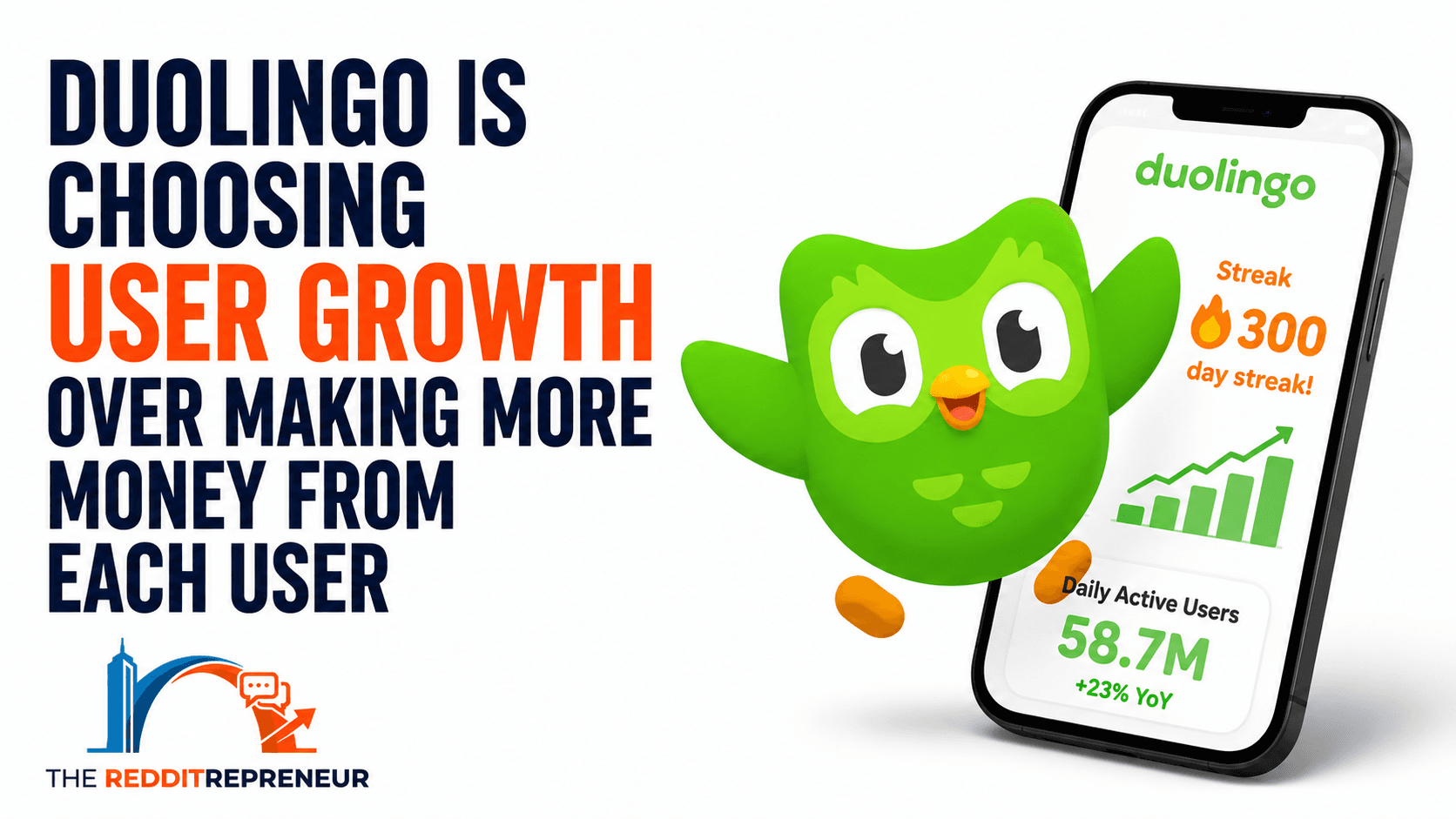
Duolingo has just given investors an interesting message.
For the moment, it would rather concentrate on getting more people to use Duolingo regularly than squeeze as much money as possible out of those users.
That decision came alongside Duolingo's latest financial results. The company reported $298.5 million in second quarter revenue, up 18% from a year earlier, while daily active users increased 23% to 58.7 million.
However, Duolingo's revenue forecast for the next quarter came in slightly below what Wall Street expected, contributing to the company's shares falling after the results.
Underneath the market reaction is a much more interesting business story.
Duolingo appears willing to sacrifice some short term monetisation if it means building a much larger group of people who use the product every day.
For a company built around streaks, notifications, characters and daily lessons, that makes a lot of sense.
But community conversations also reveal why increasing engagement alone will not solve every challenge Duolingo faces.
What is Duolingo actually doing?
Duolingo makes money in several ways, but subscriptions are particularly important.
People can use much of Duolingo for free. Users who want additional features can pay for products such as Super Duolingo or the more expensive Duolingo Max.
The obvious way to increase revenue would be to push harder to turn free users into paying customers.
Duolingo could:
- show more prompts encouraging people to upgrade
- restrict more features to subscribers
- put more advanced tools behind Duolingo Max
- increase the pressure on free users to pay
In simple terms, it could try harder to monetise its existing audience.
Instead, Duolingo is currently putting significant emphasis on getting more people to use the product and keeping those people coming back.
The thinking is straightforward.
If Duolingo can build a much larger group of regular users, it has more opportunities to make money from those people later.
Duolingo understands the power of habit
This is one of the most interesting things about Duolingo as a business.
Learning a language is difficult.
Lots of people start with good intentions and then stop.
Duolingo has spent years trying to solve that problem by making learning feel more like using a game.
Users:
- complete lessons
- earn points
- maintain streaks
- compete in leagues
- receive reminders
- unlock achievements
- interact with Duolingo's characters
Instead of simply asking:
“Did this person learn some Spanish today?”
Duolingo also wants the user thinking:
“I can't lose my 300 day streak.”
That is an extremely powerful difference.
The longer the streak becomes, the more emotionally difficult it can feel to break it.
Duolingo's Streak Revival initiative demonstrates how valuable that can become. The company temporarily allowed some people who had lost their streaks to recover them, helping bring users back into the product.
People were not necessarily returning because Duolingo suddenly offered an entirely different language course.
They were returning because something they had previously built inside Duolingo had value to them.
The habit itself had become valuable.
The Customer Insight Triangle explains why this matters
The Redditrepreneur's Customer Insight Triangle looks at three different parts of customer behaviour:
- what people say
- what people actually do
- what they ultimately choose
Duolingo is an excellent example of why all three matter.
Someone might say:
“I want to learn French.”
That tells Duolingo what the customer wants.
But their behaviour might show that they complete one short lesson every evening primarily because they do not want to lose their streak.
Their eventual choice might then be to continue using Duolingo for three years without ever buying a subscription.
Those are three different pieces of information.
Duolingo needs to understand all of them.
If the company focuses too aggressively on converting that person into a paying customer, it could introduce restrictions or prompts that make the free experience worse.
The user might leave completely.
If Duolingo keeps that person engaged instead, there are more opportunities for them to eventually:
- subscribe
- see advertising
- recommend Duolingo to somebody else
- try another Duolingo product
- become a long term user
That is why prioritising user growth can still make commercial sense.
There is an AI story underneath the numbers
Duolingo has also become one of the most interesting consumer companies experimenting with generative AI.
Its AI powered Video Call feature allows learners to practise conversations with Duolingo characters.
AI potentially gives Duolingo two major benefits.
First, it can help create new learning experiences that would previously have been difficult or expensive to provide at enormous scale.
Second, AI can potentially reduce the cost of producing and delivering some parts of those experiences.
That sounds like an obvious win.
But this is where Community Intelligence becomes particularly important.
Some users are worried about quality
Duolingo has faced criticism from parts of its community over its increasing use of AI.
Some users have reported what they believe are problems with translations, grammar, pronunciation or course quality. Others have questioned whether Duolingo's focus on AI is improving the learning experience or simply allowing the company to produce content more cheaply.
However, it would be wrong to interpret those conversations as meaning everyone dislikes Duolingo or its AI strategy.
Many users continue to describe positive experiences with the product and believe Duolingo genuinely helps them learn.
That disagreement is exactly why Community Intelligence matters.
The useful conclusion is not:
“Reddit hates Duolingo.”
The useful questions are:
- Which users believe quality is declining?
- Which languages or courses are generating complaints?
- What specifically are people experiencing?
- Are complaints concentrated around particular AI features?
- Are those perceptions actually changing behaviour?
- Are paying users reacting differently from free users?
Those answers are much more useful than measuring positive versus negative comments alone.
Engagement only works if people trust the learning
There is an important difference between Duolingo and many other consumer apps.
If someone spends another ten minutes scrolling TikTok, TikTok has largely achieved what it wanted.
Duolingo has a more complicated relationship with engagement.
People are not opening Duolingo simply because they want entertainment.
They want to learn something.
That means Duolingo cannot only optimise for:
- longer streaks
- more daily users
- more completed lessons
- more notifications opened
- more time inside the app
Those numbers matter.
But the user also needs to believe:
“This is actually teaching me correctly.”
If that belief disappears, the relationship changes.
A 500 day streak might be impressive.
But if the learner begins questioning whether the lessons are accurate, the streak cannot compensate for the underlying trust problem forever.
Belief Correction matters here
The Redditrepreneur's Belief Correction framework is particularly relevant.
Sometimes a company believes one thing about its product while communities are developing a different belief.
Duolingo can look at its internal numbers and see:
- growing daily users
- strong retention
- millions of streaks
- high engagement
- increased use of AI features
Those are legitimate signals that the product is working.
But some members of the community may simultaneously be developing another belief:
“AI is making Duolingo worse.”
Whether that perception applies to the entire product is a separate question.
The fact that the belief exists means Duolingo needs to understand where it is coming from.
Are people identifying genuine quality problems?
Are problems concentrated in particular courses?
Are users incorrectly assuming that every mistake they encounter was generated by AI?
Or has wider anxiety about Duolingo's AI strategy started affecting how people interpret ordinary product problems?
Duolingo needs to distinguish between those possibilities.
If the product is working well but the perception is wrong, the belief needs correcting with evidence.
If users have identified genuine quality problems, the product needs correcting.
That is Belief Correction in practice.
Duolingo has already seen how quickly AI perception can change
This matters because Duolingo has already experienced significant criticism around its AI messaging.
CEO Luis von Ahn previously described Duolingo as becoming an “AI first” company, which triggered criticism, particularly around the idea of using AI instead of contractors for some work.
The company later clarified its position.
The episode showed something important.
People were not necessarily objecting to every use of artificial intelligence.
They were trying to understand what Duolingo's use of AI represented.
Was AI being used to:
- make language learning better?
- create features that previously were not possible?
- personalise lessons?
- improve speaking practice?
Or was it primarily being used to:
- replace people?
- reduce costs?
- produce more content more quickly?
Those interpretations create very different reactions.
The latest results contain encouraging signals too
It would be easy to look at Duolingo's share price reaction and conclude that something is going badly wrong.
The underlying user numbers tell a more complicated story.
Duolingo reported:
- 58.7 million daily active users
- 23% year on year daily active user growth
- $298.5 million quarterly revenue
- 18% year on year revenue growth
Those are substantial numbers.
Community sentiment around Duolingo is also far from universally negative.
There are different groups reacting to different parts of the business.
Investors care about revenue growth.
Learners care about educational quality.
Paying subscribers care about whether premium features justify the price.
Long term users care about changes to courses they have spent years using.
Social media audiences might simply enjoy Duo the owl and Duolingo's unusual marketing.
Duolingo has to manage all of those relationships simultaneously.
Market Gravity is pushing Duolingo towards AI
The Redditrepreneur's Market Gravity framework also applies.
Generative AI has changed what people expect from language learning software.
Someone can now open an AI assistant and ask:
“Can we have a conversation in Spanish and can you correct me whenever I make a mistake?”
The AI can immediately respond.
That was much harder for ordinary consumers to access only a few years ago.
The wider AI market is therefore pulling language learning towards features such as:
- personalised conversations
- instant explanations
- adaptive lessons
- real time feedback
- natural speaking practice
- personalised learning
Duolingo cannot simply ignore that change.
Competitors can build these capabilities.
Customers can access them elsewhere.
That is Market Gravity.
Duolingo has to respond to what is happening around it.
The challenge is introducing those capabilities without damaging the qualities that made people trust and enjoy Duolingo in the first place.
The real Duolingo story is bigger than its share price
Wall Street looked at Duolingo's latest forecast and worried about how quickly revenue will grow.
That is understandable.
Investors ultimately expect businesses to make money.
But Duolingo is making a longer term bet.
It believes building a larger and more engaged audience today can create a stronger business tomorrow.
Nearly 59 million people opening Duolingo every day gives the company an enormous audience that it can potentially monetise over time.
The Community Intelligence question is what sits underneath that engagement.
Are people returning because they genuinely believe Duolingo is helping them learn?
Are they returning because they do not want to lose their streak?
Are they returning because Duolingo has successfully turned language learning into entertainment?
For Duolingo, the ideal answer is probably all three.
AI can help it create new learning experiences. Gamification can keep millions of people returning. Social media can keep Duo culturally relevant.
But none of those things replaces the basic promise at the centre of the product:
People open Duolingo because they want to learn.
If Duolingo can continue growing engagement while maintaining confidence in the quality of that learning, prioritising users over short term monetisation could prove extremely valuable.
If engagement keeps rising while trust in the learning experience falls, the numbers could eventually hide a much more important problem.
For Duolingo, the streak is valuable. The trust behind the streak is even more valuable.
Turn conversations into clarity
Explore the Community Intelligence platform or commission a focused audit of your brand, competitors and market.