
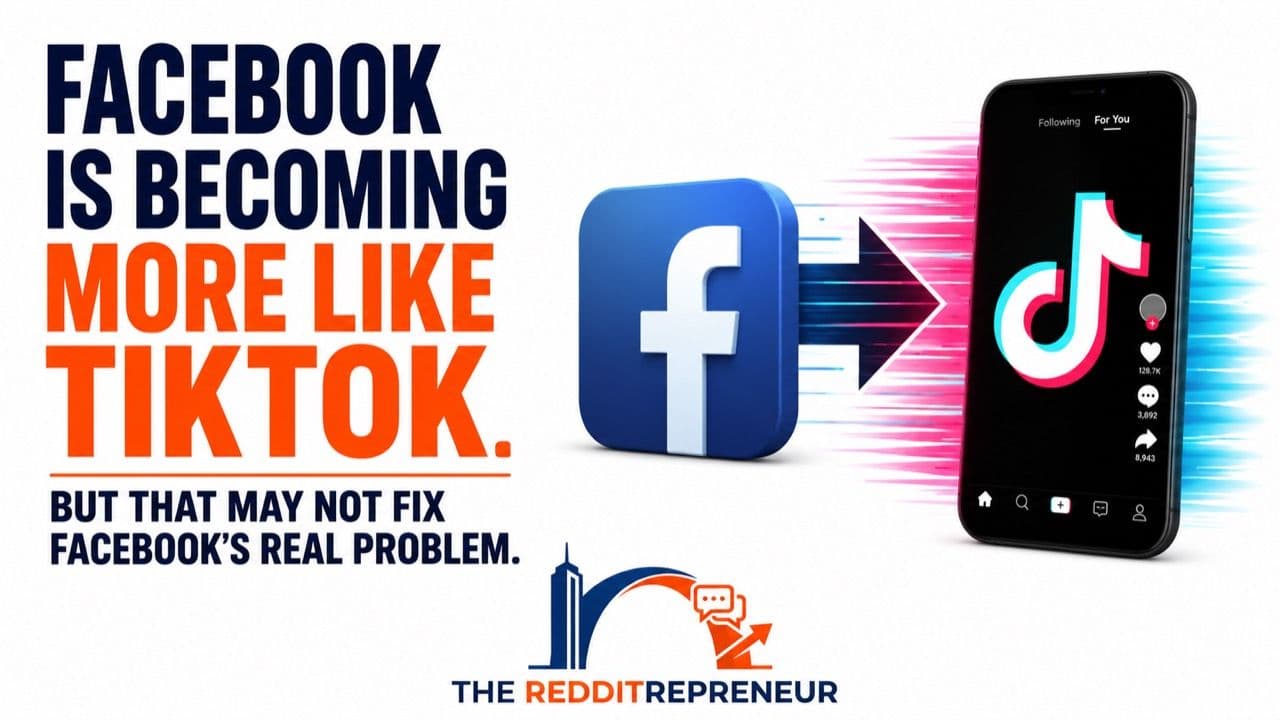
Facebook is becoming more like TikTok.
But first, an important point.
This is a test, not a full launch.
Meta says the test will begin later in 2026.
It will involve a subset of people in international countries where video is already heavily used.
Meta has not named those countries.
It may test the idea in the United States in 2027.
People included in the test will open Facebook to full screen video.
They will be able to opt out and return to a feed first experience.
The classic feed will also remain available as the second tab in the app.
So this is not a worldwide change for everyone.
It is not a confirmed permanent default.
Users in the test can move through videos picked for them by Facebook’s system.
The experience looks much closer to TikTok than the Facebook many people originally joined.
Meta clearly wants to learn whether some people will watch more video this way.
That makes sense.
Short videos are popular.
TikTok has shown how powerful an endless stream of recommended videos can be.
But Facebook may be solving the wrong problem.
Facebook’s biggest issue may not be that its video feed is less entertaining than TikTok.
The real issue may be that people are no longer sure what Facebook is for.
Facebook and TikTok Were Built for Different Reasons
TikTok is mainly built around discovery.
People open it to see entertaining videos from creators they may not know.
The app quickly learns what keeps each person watching.
Facebook began with a different purpose.
People joined Facebook to keep up with:
- Friends.
- Family members.
- School friends.
- Local businesses.
- Neighbours.
- Clubs.
- Events.
- Community groups.
TikTok helps people discover strangers.
Facebook originally helped people stay connected to people they already knew.
Those are not the same job.
People Did Not Join Facebook for TikTok
There is nothing wrong with Facebook offering more video.
Many people enjoy Reels.
Creators want more reach.
Businesses want more attention.
But people did not originally join Facebook because they wanted an endless stream of videos from strangers.
They joined because the people and groups they cared about were already there.
That is why copying TikTok may not solve Facebook’s deeper problem.
The layout can be copied.
The scrolling style can be copied.
The recommendation system can be copied.
But the reason people use TikTok cannot simply be moved into another app.
Meta May Be Fixing the Wrong Problem
Meta may believe Facebook needs to be more entertaining.
That may be partly true.
But some Facebook users say they struggle to see posts from friends, family members and groups they chose to follow.
Instead, they may see:
- Recommended videos.
- Suggested pages.
- Advertising.
- Posts from strangers.
- Content selected by Facebook.
This creates a strange situation.
Facebook is testing more content from people a user may not know.
But some users want Facebook to do a better job of showing them people they already know.
The problem may not be a lack of video.
It may be a loss of connection.
Watching More Does Not Mean Caring More
A Facebook TikTok style feed may keep people inside the app for longer.
That is useful for Meta.
More time inside the app can mean more advertising opportunities.
But time spent watching is not the same as feeling connected.
There are four different things to consider.
Attention
How long did someone watch?
Participation
Did they post, comment or help another person?
Connection
Did the experience strengthen a relationship?
Belonging
Did the person feel part of a group or community?
A full screen video feed may increase attention.
But it may not increase participation, connection or belonging.
It could even reduce them.
Facebook Is Now Several Different Products
Facebook no longer has one simple purpose.
Different people use it for different reasons.
Some use it to keep up with family.
Some use Facebook Groups.
Some use Facebook Marketplace.
Some organise events.
Some follow local news.
Some run businesses.
Some create videos.
Some only open the app when they receive a birthday notification.
This means Facebook is trying to serve many different groups at the same time.
A change that helps one group may annoy another.
Creators may welcome a stronger Facebook video feed.
Someone who only wants to see family photos may dislike it.
Advertisers may want more video viewing.
Group administrators may want Facebook to improve conversations and community tools.
There may no longer be one Facebook user experience that works for everyone.
Facebook’s Real Strength May Be the Boring Parts
The most valuable parts of Facebook may not be the parts that attract the most attention.
They may be:
- Groups.
- Marketplace.
- Events.
- Local information.
- Family networks.
- Community recommendations.
These features are not as fashionable as short form video.
But they are hard for other platforms to copy.
A local Facebook group may contain years of relationships, advice and shared history.
Marketplace works because large numbers of nearby buyers and sellers already use it.
Family networks stay because moving everyone to a new platform is difficult.
Facebook’s advantage may not be that it can become another TikTok.
Its advantage may be that it already contains communities that do not exist anywhere else.
Facebook May Be Losing Its Identity
This is where Community Intelligence becomes useful.
Community Intelligence means looking at real conversations to understand what people believe.
Usage data can tell Meta what people click.
It can show which videos they watch.
It can measure how long they stay.
But that data may not clearly explain what people believe Facebook is for.
Customer conversations and online communities can reveal that.
A person might watch several recommended videos while still saying they mainly use Facebook for Groups.
Another person might spend an hour on Facebook but still feel they rarely see posts from friends.
A business owner may use Marketplace every day but dislike the rest of the app.
The numbers show activity.
The conversations explain the meaning behind that activity.
A Belief About Facebook May Be Changing
The Redditrepreneur calls this Belief Correction.
That simply means people are changing what they believe about a company or product.
The old belief may have been:
Facebook is where I keep up with people and communities I know.
The newer belief may become:
Facebook is another app showing me videos from strangers.
That belief matters.
Once people stop seeing Facebook as a place for connection, every new video update can make that feeling stronger.
Even useful changes may be viewed as proof that Facebook no longer understands its original purpose.
The Story Is Becoming Very Simple
Facebook’s complicated product plans can quickly turn into one simple public story:
Facebook is trying to copy TikTok.
The Redditrepreneur calls this Narrative Compression.
That means a complicated situation gets reduced to one easy sentence.
The sentence may leave out important details.
But it is memorable.
It is also easy to repeat.
Each new video feature can then be seen as more proof that the simple story is true.
Why People May Stay Anyway
Facebook still has enormous Community Gravity.
Community Gravity means a platform is difficult to leave because so many useful people, groups and relationships are already there.
People may dislike Facebook’s direction but continue using it because:
- Their family is there.
- Their local group is there.
- Their customers are there.
- Their business page is there.
- Marketplace is there.
- Years of photos and memories are there.
This gives Meta room to make changes.
But it can also hide dissatisfaction.
People staying does not always mean they are happy.
Sometimes it only means leaving would be inconvenient.
What Meta Should Do
Meta should not assume that all Facebook users want the same experience.
It should study what different groups actually use Facebook for.
That means looking separately at:
- Family users.
- Group members.
- Marketplace users.
- Small businesses.
- Creators.
- Video viewers.
- Event organisers.
- Local communities.
Meta should then give people more control over the experience they want.
A user who wants videos should be able to choose a video first experience.
A user who wants friends and groups should be able to choose that clearly.
The goal should not be to force every user into the same feed.
It should be to help each person reach the part of Facebook they value most.
What Other Companies Can Learn
Facebook is not the only company facing this problem.
When growth slows, businesses often copy what is working for a competitor.
A software company adds the same AI features as another platform.
A streaming service copies TikTok style videos.
A retailer copies a rival’s loyalty programme.
A social platform copies another app’s layout.
Sometimes this works.
But there is a risk.
The company may become more like its competitor while becoming less useful to its own customers.
Before copying a popular feature, businesses should ask:
- Why do our customers use us?
- What would they miss if we disappeared?
- Does this change strengthen that reason?
- Are we solving a real customer problem?
- Are we weakening what makes us different?
Facebook’s Real Problem Is Not Video
Facebook may successfully make people watch more videos.
But that will not automatically solve its identity problem.
The bigger question is whether people still understand why Facebook matters.
TikTok knows what it is.
It is a discovery and entertainment platform.
Facebook is trying to be:
- A social network.
- A video platform.
- A marketplace.
- A group platform.
- A creator platform.
- A local noticeboard.
- An advertising system.
Trying to be everything can make its social media platform identity harder to explain.
What This Means
- Facebook and TikTok serve different needs.
- More viewing does not always create more connection.
- Facebook’s biggest strengths may be Groups, Marketplace and local communities.
- Copying a competitor can weaken what customers valued about the original product.
Final Takeaway
Facebook is becoming more like TikTok.
That may increase video viewing.
It may give creators more reach.
It may create more advertising opportunities.
But it may not fix Facebook’s real problem.
People did not join Facebook because they wanted TikTok.
They joined because people and communities they cared about were there.
Meta should be careful not to improve the part that keeps people watching while weakening the part that made them care.
That is the difference between attention and belonging.
And it is why product data alone is not enough.
Data can show what people do.
Community Intelligence helps explain what people still want the product to be.
Community Intelligence Audit
Understand What Customers Believe Your Product Is For
A product dashboard can show what customers clicked.
It cannot always explain what customers believe the product is for.
The Redditrepreneur’s Community Intelligence Audit turns real customer conversations into clear insights about product identity, trust, unmet needs and future opportunities.
Explore the Community Intelligence Audit Explore the Community Intelligence Platform