

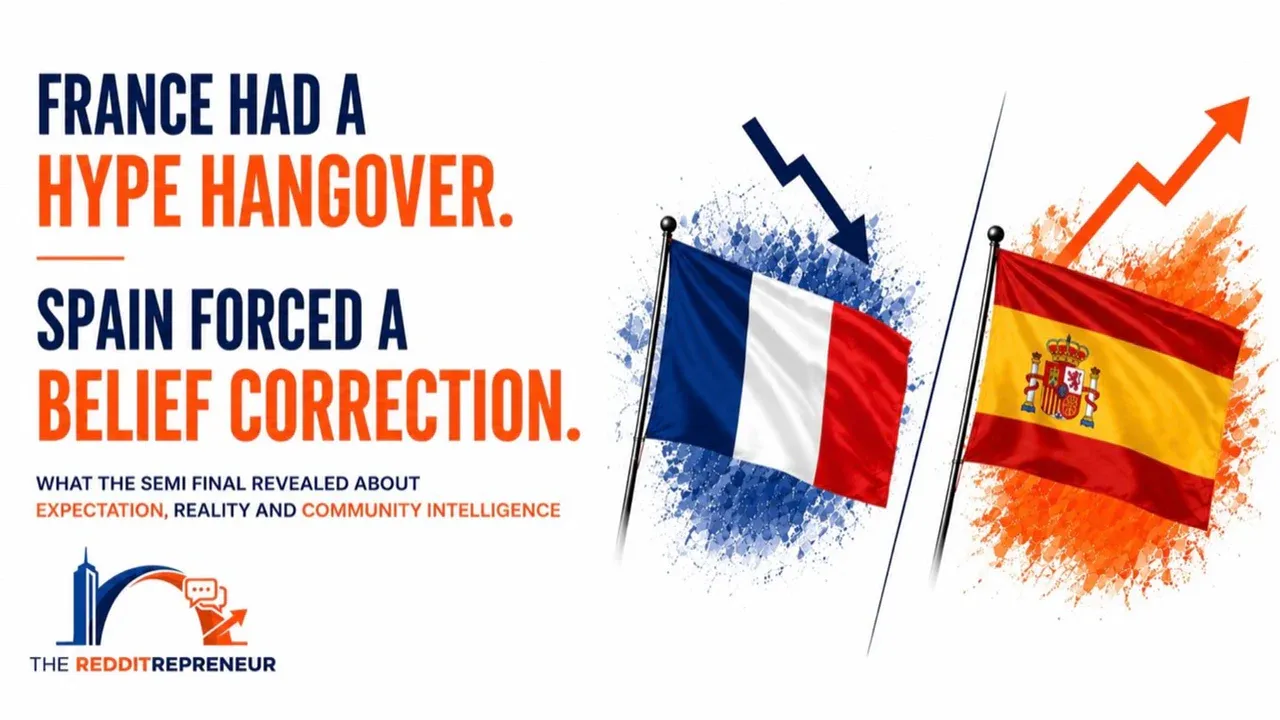
One match can change two stories at once.
France entered their World Cup semi final against Spain carrying the weight of expectation.
Spain entered it carrying a different burden.
France were expected to prove how good everyone already believed they were.
Spain were still trying to convince parts of the football world that they were better than many had realised.
When Spain won 2–0, the result did more than decide who reached the World Cup final.
It triggered two contrasting shifts in community perception.
France experienced a Hype Hangover.
Spain created a Belief Correction.
The same ninety minutes made one team look smaller than the story surrounding them and made the other look bigger than the story people had previously told.
That is Community Intelligence in action.
France Entered With the Weight of Expectation
France did not arrive at the semi final as an ordinary contender.
They possessed one of the tournament’s strongest squads, world class players across multiple positions and the experience of competing deep into major tournaments.
Those qualities created more than confidence.
They created expectation.
France were not simply expected to compete.
They were expected to demonstrate why their squad, experience and attacking talent made them one of the most powerful teams in international football.
That distinction matters because communities do not evaluate every team against the same standard.
A smaller football nation reaching a World Cup semi final may be celebrated regardless of the result.
For France, reaching the same stage can still be viewed as falling short.
The difference is expectation.
What Is Hype Hangover?
The Redditrepreneur’s Hype Hangover framework describes what happens when the expectations surrounding something become greater than the experience or outcome it eventually delivers.
The sequence is simple:
- Expectations rise.
- Excitement becomes part of the public narrative.
- The real experience arrives.
- Reality fails to match the imagined outcome.
- Community conversation shifts from anticipation to disappointment.
The product, person or team does not necessarily have to be poor.
It only has to perform below the level people had been encouraged to expect.
That is what makes Hype Hangover so powerful.
The judgement is not based entirely on objective performance.
It is based on the distance between expectation and reality.
France’s Semi Final Became a Hype Hangover
France reached the last four of the World Cup.
On paper, that remains an impressive tournament.
But community perception is rarely built from the result alone.
It is built from what people thought should have happened.
Spain controlled the semi final and won 2–0.
The disappointment therefore came from more than elimination.
It came from the contrast.
France had looked capable of overwhelming almost anyone during the tournament.
They entered the semi final with elite talent, deep tournament experience and the reputation of a team built for major occasions.
But against Spain, the version of France that communities expected never fully appeared.
That is the Hype Hangover.
The narrative moves from:
“France may be the strongest team in the tournament.”
to:
“France did not show enough when it mattered most.”
A semi final finish becomes framed as underachievement because the expectation had risen beyond simply reaching the final four.
Expectations Change the Meaning of Results
This is one of the most important lessons within Community Intelligence.
The same outcome can mean completely different things depending on the expectations surrounding it.
For one team, a semi final represents progress.
For another, it represents failure.
For one brand, selling one million products represents extraordinary growth.
For another, it represents missing a target.
For one film, strong opening numbers are celebrated.
For another, they are labelled disappointing because the marketing created expectations of a cultural phenomenon.
Communities do not judge outcomes in isolation.
They judge outcomes against the story they had already accepted.
France’s story was built around dominance, depth and another potential final.
Once that expectation was established, anything less created the conditions for a Hype Hangover.
Spain Entered With a Different Narrative
Spain were hardly unknown or unproven.
They were already respected and had shown strong performances throughout the tournament.
But public perception does not always move as quickly as performance.
France had the more obvious collection of headline stars.
Other major teams carried more media attention and emotional gravity.
Spain were respected, but portions of the wider conversation still treated them as one of several contenders rather than the team setting the tournament’s standard.
Then the evidence became increasingly difficult to ignore.
Spain kept winning.
Their tactical identity remained clear.
Their performances remained controlled.
Their confidence grew.
The semi final did not suddenly make Spain excellent.
It made more people recognise the excellence that had already been present.
That is Belief Correction.
What Is Belief Correction?
The Redditrepreneur’s Belief Correction framework describes the process through which communities revise an existing belief after receiving enough contradictory evidence.
It happens when the original narrative can no longer explain reality.
The sequence usually looks like this:
- A community forms an initial belief.
- New evidence challenges that belief.
- The evidence repeats.
- The old explanation becomes less credible.
- The community updates its collective understanding.
Belief Correction is not simply changing an opinion.
It is recognising that the previous opinion was incomplete, outdated or wrong.
Spain’s run created that process.
The belief may have been:
“Spain are good, but perhaps not the tournament’s most dangerous team.”
The accumulating evidence changed it to:
“Spain may have been the best team here all along.”
Spain Forced the Football World to Recalculate
Spain’s victory over France was convincing because it addressed the doubts that may have remained.
Could they control a team with France’s athleticism?
Could they contain elite attacking players?
Could they turn possession and tactical control into a decisive result against one of the tournament favourites?
They answered those questions.
Spain restricted France, controlled the match and reached the World Cup final.
The result forced communities to revisit their assumptions.
Spain were no longer simply playing attractive football.
They were controlling elite opponents.
They were no longer merely a team with talented players.
They were a complete tournament side.
They were no longer an interesting alternative to the favourites.
They had become the standard against which the remaining teams would be measured.
One Match. Two Community Narratives.
This is what makes the semi final such a useful Community Intelligence case study.
France and Spain experienced the same event.
But they emerged with opposite narrative movements.
France
Previous belief: France have the talent and experience to reach another final.
New evidence: They were comprehensively beaten by Spain.
Community movement: Expectation turns into disappointment.
Framework: Hype Hangover.
Spain
Previous belief: Spain are strong, but perhaps not receiving the same level of attention as other favourites.
New evidence: They controlled and defeated France.
Community movement: Respect turns into reassessment.
Framework: Belief Correction.
The scoreline was the same for everyone.
Its meaning was not.
Why Communities Update Some Beliefs Faster Than Others
Belief Correction rarely happens after one isolated moment.
Communities are often resistant to changing established narratives.
A team may win once and be described as fortunate.
It may win twice and still be described as untested.
It may dominate repeatedly and still find people relying on an outdated perception.
Eventually, however, the weight of evidence becomes too large.
Spain’s semi final victory mattered because it was not an isolated performance.
It was the latest proof in a sequence.
Their tournament results, tactical consistency and ability to control France all pointed in the same direction.
The evidence accumulated until the belief had to move.
France experienced the reverse.
Their reputation was so strong that one disappointing match could not erase everything they had achieved.
But because the semi final was the moment expected to validate the hype, defeat carried disproportionate narrative weight.
The Business Lesson Behind the Football
These frameworks extend far beyond sport.
A company can experience Hype Hangover when:
- A heavily promoted product launches with an ordinary experience
- A viral restaurant fails to match customer expectations
- An AI platform promises to transform work but only delivers a modest improvement
- A major rebrand generates excitement without improving the customer experience
A company can trigger Belief Correction when:
- A smaller competitor repeatedly outperforms the category leader
- A previously overlooked product earns sustained recommendations
- Customer evidence contradicts an old reputation
- A brand proves it has improved after years of criticism
The strategic lesson is the same.
Communities are always comparing reality with prior belief.
When reality underperforms the belief, Hype Hangover follows.
When reality exceeds the belief, Belief Correction becomes possible.
Community Intelligence Is About Narrative Movement
Traditional analysis may record that Spain beat France 2–0.
Community Intelligence asks what that result changed.
It examines:
- Which existing beliefs were strengthened
- Which beliefs became harder to defend
- Whose reputation rose
- Whose expectations became a burden
- What simplified narrative communities carried forward
The match did not merely send Spain into a final and France out of contention.
It reorganised perception.
France became the team that failed to match the scale of its expectation.
Spain became the team many people realised they had underestimated.
Final Thought
France’s tournament was not objectively disastrous.
They reached a World Cup semi final and remained one of the strongest national teams in football.
But the hype surrounding them created a higher standard than the result they ultimately delivered.
That is why the disappointment felt larger than the finish itself.
Spain’s story moved in the opposite direction.
They did not suddenly become excellent by beating France.
They provided the clearest evidence yet that the public narrative had not fully caught up with their quality.
France suffered a Hype Hangover.
Spain created a Belief Correction.
One team fell below the belief surrounding them.
The other finally forced the belief to rise.
That is how communities transform results into narratives.
Editor’s Note
Hype Hangover and Belief Correction are Community Intelligence frameworks developed by The Redditrepreneur to explain how expectations, evidence and collective perception shape public narratives.
Hype Hangover explains what happens when anticipation exceeds reality.
Belief Correction explains how communities revise an established view when new evidence becomes impossible to ignore.
Together, the frameworks demonstrate why tracking positive or negative sentiment is not enough.
The more important question is how an event changes what a community believes.