

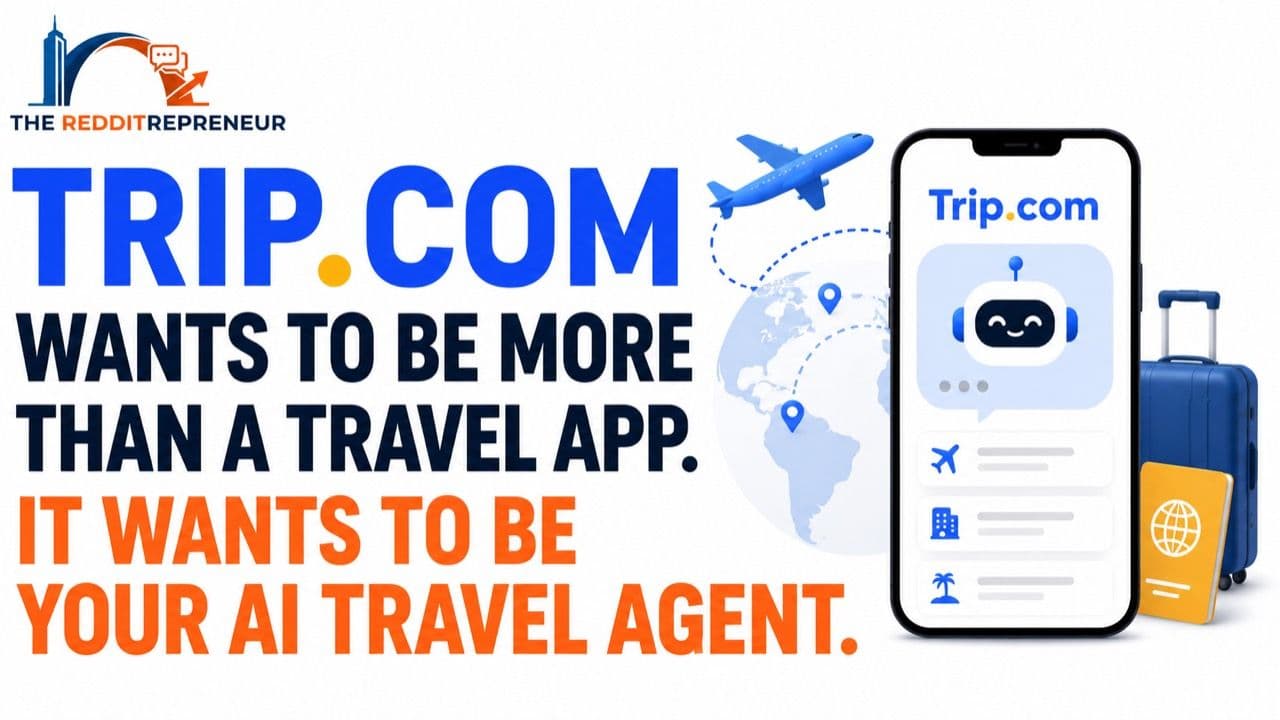
Editor's Note
Most stories about travel AI focus on convenience.
They ask whether an AI tool can find a hotel, plan a journey or suggest somewhere to visit.
The more important question is about trust.
What happens when the same company recommends the trip, ranks the options and then sells the booking?
That is where Community Intelligence becomes important.
The Short Answer
Trip.com wants AI to make travel planning easier.
Travellers could spend less time searching and receive more personal suggestions.
But Trip.com may increasingly influence what people discover, compare and buy.
The company will need to show that its recommendations are useful for the traveller, not simply profitable for the platform.
What Trip.com Has Confirmed
Trip.com has an AI travel assistant called TripGenie.
It first launched as TripGen in February 2023 and was later renamed TripGenie.
Trip.com also says the tool can compare hotels and help with questions about flights, attractions and travel plans.
Its newer tools include menu help, live translation and image recognition.
Trip.com's July 2026 product update describes these current features.
Trip.com describes TripGenie as globally available.
However, its privacy notice says some AI features operate only in certain countries and regions.
Features can also vary by language, market and app version.
TripGenie can help a traveller reach booking options.
Trip.com has previously explained that the traveller still chooses and completes the booking.
It would therefore be wrong to say that every user can ask TripGenie to complete an entire holiday without checking or approving the booking.
Trip.com Wants to Be More Than a Booking App
Trip.com wants artificial intelligence to help travellers through more of their journey.
Artificial intelligence, usually called AI, is software that can understand questions and create useful answers.
In travel, that could mean helping someone:
- Choose a destination.
- Build a travel plan.
- Find flight options.
- Compare hotels.
- Discover local activities.
- Move towards a booking.
- Ask questions about a change to a trip.
This sounds useful.
Planning a holiday can take hours.
People often move between Google, travel blogs, YouTube, Reddit, maps, airline websites and hotel platforms before deciding what to book.
An AI travel assistant could bring more of that work into one place.
But there is a bigger question.
Can travellers trust advice from a company that also earns money when they make a booking?
What Is Trip.com?
Trip.com is an online travel company.
People can use it to search for and book flights, hotels, trains, car hire and attractions.
The platform brings many travel options together.
Instead of visiting several airline and hotel websites, a traveller can compare different choices in one place.
That includes commissions connected to bookings made through its platforms.
What Is an AI Travel Agent?
A traditional travel agent is a person who helps customers plan and book trips.
An AI travel agent tries to do parts of this work through software.
A traveller might type:
I want a five day family holiday somewhere warm in October. I have a budget of £2,000.
An AI system could suggest suitable destinations, possible flights, family friendly hotels and activities.
It may also create a daily travel plan.
This is different from an ordinary search box.
A normal search gives the user a list of results.
An AI assistant tries to understand the whole request and provide a more complete answer.
Why Travellers May Find This Useful
Travel planning can be tiring.
A person may need to answer many questions.
Where should we go?
Which airport should we use?
Is the hotel near the main attractions?
Is the area suitable for children?
Does the price include luggage?
Are the reviews trustworthy?
Would booking directly be cheaper?
An AI assistant could make this simpler.
It could remember the traveller's needs and remove options that are not suitable.
This could be useful for families, people planning complicated trips and travellers with a strict budget.
It may also help people who do not have time to research everything.
Trip.com Wants to Move Closer to the Decision
A booking app normally enters the journey after the customer has decided where they want to go.
The customer chooses a destination first.
They then use the platform to find a flight or hotel.
An AI travel assistant could bring Trip.com into the journey much earlier.
The traveller may ask:
Where should I go?
This matters.
The company is no longer only helping the customer buy a trip.
It may also help decide which trip the customer wants.
That gives the platform more influence.
From Booking Tool to Decision Tool
There is a major difference between helping someone complete a decision and helping someone make the decision.
A booking tool says:
Here are hotels in Barcelona.
A decision tool says:
Barcelona may suit your trip, and these are the hotels you should consider.
The second role requires much more trust.
The traveller needs to believe that the recommendations are relevant, accurate, safe, fair and up to date.
They may also want to know why one option appeared above another.
The Recommendation Problem
Trip.com may earn money when a traveller makes a booking.
That does not automatically make its recommendations unfair.
Travel agents have long earned money from bookings.
But AI can make the commercial relationship less visible.
A human travel agent can explain why a hotel is being recommended.
An AI answer may simply place one hotel at the top.
The traveller may not know:
- Why it appeared first.
- Whether Trip.com earns more from that booking.
- Whether a commercial partner received more visibility.
- Whether the cheapest direct price was checked.
- Whether all suitable options were considered.
The problem is not only whether the result is good.
It is whether the traveller understands how the result was chosen.
The Neutrality Illusion
The Redditrepreneur calls this the neutrality illusion.
The neutrality illusion happens when a platform looks like a neutral helper but has its own business interests behind the answer.
Imagine asking a shop assistant which television is best.
The assistant may give honest advice.
But the customer would still want to know whether the shop earns more money from one brand.
AI travel recommendations create a similar question.
Trip.com can help people.
It can also benefit from the choices they make.
The platform must be clear about both sides.
AI Answers Can Feel More Trustworthy Than Lists
People understand that search results have been ranked.
They may compare several options, read reviews and visit other websites.
An AI answer feels different.
It can sound confident and personal.
But the AI is still using information, rules and business systems chosen by the company behind it.
A confident answer is not always a neutral answer.
This is why transparency matters.
Transparency simply means clearly explaining what is happening.
Trip.com should explain:
- What information the AI uses.
- How recommendations are ranked.
- Whether commercial deals affect the answer.
- When information was last updated.
- Which parts of the answer may be uncertain.
- Whether sponsored options are included.
The Community Trust Check
Travellers rarely rely on one source.
A person may use Trip.com to find a shortlist.
They may then search Reddit, YouTube, Google Maps or travel forums to check whether the recommendation feels believable.
- Ask an AI assistant for ideas.
- Receive a shortlist.
- Search communities for real experiences.
- Read recent hotel reviews.
- Compare the direct price.
- Decide whether to book.
Online communities are becoming a trust layer.
A trust layer is an extra source people use to check whether a claim can be believed.
Trip.com may provide the options.
Communities help people judge those options.
Why Community Intelligence Matters
Trip.com's booking data can show what travellers bought.
It may show the destination, hotel, price and recommendation that received a click.
But this data does not fully explain what the traveller believed.
A customer may complete a booking while still feeling unsure.
They may book because the price was low, they were in a hurry or the cancellation policy felt safe.
After booking, they may still tell others that they would check a community before trusting the recommendation.
That belief matters.
Community Intelligence looks at the conversations around the booking.
It helps companies understand what travellers trust, question and verify elsewhere.
Traditional data records the transaction.
Community Intelligence explains the belief behind it.
Community Intelligence as an Early Warning System
Online communities can reveal problems before they appear in company reports.
Travellers may begin saying that recommendations feel sponsored, repeated or out of date.
They may say the AI ignored their budget or gave a hotel description that did not match reality.
One complaint does not prove a wider problem.
Repeated patterns deserve attention.
They may reveal trust problems, wrong information or weak explanations.
Community Intelligence can help companies notice these patterns early.
The Danger of Repeated Recommendations
AI systems often use existing information and popular behaviour.
This can create a problem.
The most popular destinations may keep receiving more recommendations.
The most visible hotels may keep gaining more bookings.
Smaller businesses may become harder to discover.
A traveller asking for a unique experience may receive the same well known suggestions as everyone else.
This can create recommendation sameness.
Recommendation sameness happens when different people receive very similar answers, even when their needs are different.
That would make the AI easier to use but less useful.
The Feedback Loop
AI recommendations can create a feedback loop.
A feedback loop is a cycle where one result makes the same result more likely in the future.
- A hotel is already popular.
- The AI recommends it more often.
- More people book it.
- The hotel gains more reviews and data.
- The AI sees it as even more popular.
- The hotel is recommended again.
This does not mean the hotel is bad.
But it can make it harder for less visible hotels to compete.
Trip.com should make sure that popularity does not become the only sign of quality.
Personalisation Must Not Become Surveillance
AI travel tools may become more useful when they know more about the traveller.
The system might use previous bookings, spending habits, travel dates and hotel preferences.
This can create better recommendations.
It can also feel uncomfortable.
Personalisation means adjusting a service to suit a specific person.
Surveillance means watching and recording more information than the person reasonably expects.
The line between the two can be unclear.
The same notice explains the choices available to users and how data may be shared.
Travellers should read the version that applies in their country.
What Trip.com Should Do
Trip.com has a real opportunity to make travel planning easier.
But trust must be built into the product.
- Explain why each option is recommended. Show how it matches the customer's budget, location and travel needs.
- Clearly label sponsored recommendations. Customers should know when commercial payments affect visibility.
- Separate advice from advertising. Paid options should not look identical to neutral suggestions.
- Show when information was updated. Prices, opening times and travel rules can change quickly.
- Make uncertainty visible. The AI should admit when it lacks reliable information.
- Let travellers adjust the answer. Customers should be able to change the budget, dates and other needs easily.
- Make privacy controls simple. People should understand and control how their data is used.
- Monitor community conversations. Repeated concerns in travel communities may reveal early problems.
- Keep a human support route. Travel problems can be stressful and may need a person.
- Measure trust as well as bookings. A booking does not always prove that the customer trusted the recommendation.
What Every Platform Should Learn
This story is bigger than Trip.com.
AI is moving companies from helping customers complete decisions to helping customers make decisions.
This includes shopping, financial services, food delivery, property, jobs and healthcare.
The closer a platform moves towards making the decision, the more trust it needs.
Companies must explain why something was recommended, whose interests it serves and which information was used.
AI should make decisions easier to understand.
It should not hide how the decision was made.
Community Intelligence Insight
A booking tells Trip.com what a traveller bought.
A community conversation explains why the traveller trusted or doubted the recommendation.
Companies that only measure clicks and bookings may miss the beliefs forming around their AI products.
Those beliefs can shape whether customers return, recommend the service or check another source before buying.
The Biggest Opportunity
Trip.com could become a useful AI travel assistant.
It could save people time and make complicated trips easier to plan.
It could help people discover destinations they had not considered.
But the strongest AI travel agent will not simply give the fastest answer.
It will give an answer the traveller understands and trusts.
What Travellers Should Remember
AI can be a useful starting point.
It should not always be the final word.
Before making an important travel booking:
- Check recent reviews.
- Compare prices.
- Read the cancellation terms.
- Confirm important details directly.
- Check official travel advice.
- Look for recent experiences from real travellers.
- Be careful when an answer sounds too certain.
AI can help you build the shortlist.
You should still make the final decision.
Frequently Asked Questions
What is an AI travel agent?
An AI travel agent is software that helps people plan parts of a trip. It may suggest destinations, flights, hotels and activities based on the traveller's request.
Does Trip.com use AI?
Yes. Trip.com's AI travel assistant is called TripGenie. Trip.com says it can help with travel questions, itineraries, hotel comparison and other tasks. The exact features available can vary by country, language and app version.
Can an AI book an entire holiday?
Some AI travel tools can help people search, plan and move towards a booking. Trip.com has said that TripGenie shows relevant options while the customer chooses and completes the booking. Important details should still be checked carefully.
Are AI travel recommendations neutral?
Not always. A travel platform may earn money from certain bookings. Customers should be told when commercial relationships or sponsored placements affect a recommendation.
Should I trust an AI travel agent?
AI can be useful for ideas and shortlists. Travellers should still check recent reviews, prices, cancellation rules, official advice and important booking details.
Why do travellers check Reddit after using a travel platform?
Reddit and other communities contain personal experiences from travellers. People use these conversations to check whether a platform's recommendation matches real customer experiences.
Sources
- Trip.com Newsroom, current TripGenie product updates and 2026 usage information.
- Trip.com, TripGenie launch and product capabilities.
- Trip.com, explanation of how TripGenie leads users towards booking options.
- Trip.com Group 2025 annual report, filed in 2026.
- Trip.com privacy notice, updated in 2026.
Do Customers Trust Your AI Recommendations?
The Redditrepreneur helps companies understand the real conversations behind customer decisions.
Explore a Community Intelligence Audit, an AI Authority Audit or a Reddit Authenticity and Risk Audit.
Explore Community Intelligence Audits Visit The Redditrepreneur