

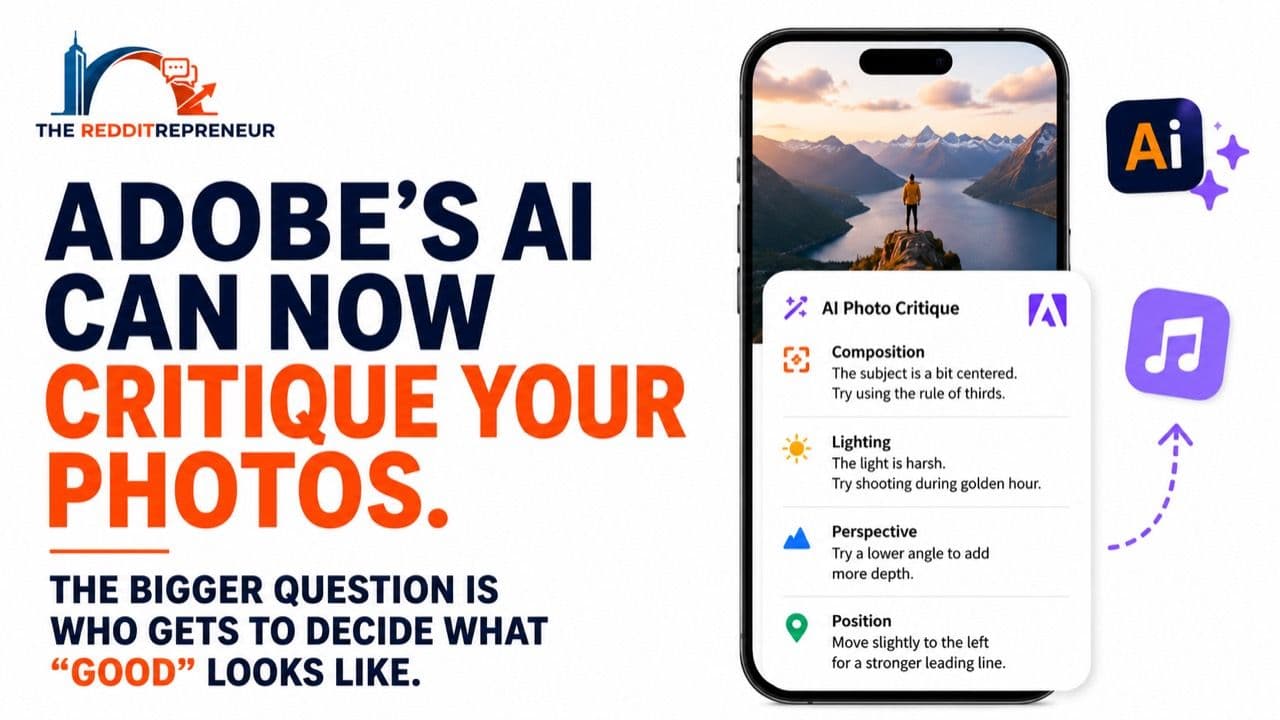
Adobe is exploring an AI photo critique feature inside the AI Playground for Project Indigo.
Project Indigo is Adobe's experimental camera app.
The feature can look at a photograph and offer a critique.
Adobe says it can also suggest ways to reshoot or edit the image.
Adobe is still working on parts of the idea, including suggestions about composition and cropping.
This is not a finished feature available to every Adobe customer.
For a beginner, it could be genuinely useful.
Not everyone can afford photography lessons.
Not everyone has a professional photographer available to review their work.
An AI assistant could give people immediate advice and help them understand why a picture does not look the way they expected.
But this feature also creates a much bigger question.
Who taught the AI what a good photograph looks like?
Photography Is Not Only About Technical Quality
A photograph can be sharp, bright and perfectly framed.
That does not automatically make it meaningful.
Photography also involves emotion, memory, timing, culture, personal taste and intentional imperfection.
A blurred photograph can still feel powerful.
A badly lit family photo can still be deeply important.
An off-centre subject may create tension on purpose.
A photograph can break every traditional rule and still connect with people.
This means there is a difference between technical quality and human meaning.
AI may be good at spotting technical problems.
It may notice that a photograph is too dark.
It may suggest moving the subject.
It may recommend using the rule of thirds.
The rule of thirds is a common guide that places the main subject away from the exact centre of the picture.
But the AI may not understand why the photographer made a choice.
It may not understand the memory behind the image.
It may not understand what the picture means to the person looking at it.
AI Is Moving From Making Creative Work to Judging It
Most discussions about creative AI have focused on tools that create images, videos, music or writing.
Adobe's experiment points towards something different.
AI is starting to judge creative work.
That matters because a system that judges creativity can influence what people create next.
A user may take a photograph.
The AI says the subject could move.
The user changes the composition.
The AI says the light could be softer.
The user waits until sunset.
The AI says the image could use more contrast.
The user edits it.
Each suggestion may be useful.
But over time, users may start creating photographs that follow the same patterns.
The AI does not need to force people to copy one style.
It only needs to reward certain choices often enough.
What Is Algorithmic Taste Formation?
Algorithmic Taste Formation happens when automated systems repeatedly recommend certain creative choices until those choices begin shaping what people believe is good.
An automated system is software that applies rules or patterns without a person making every decision.
The process may look like this:
- The AI learns common photography rules.
- It recommends those rules to users.
- Users change their photographs.
- Similar styles become more common.
- The AI sees more examples that support the same rules.
The result could be photographs that are technically stronger but increasingly similar.
The most powerful creative AI may not be the tool that makes the art.
It may be the tool that teaches people what art should look like.
Teacher or Judge?
The value of Adobe's tool may depend on how it speaks to the user.
A good teacher may say:
You could try moving the subject to the left. You could also keep the current framing if you want the image to feel uncomfortable.
It may offer three different approaches.
A judge may simply say:
The composition is wrong. Move the subject. This photograph needs improvement.
That difference matters.
Photography is subjective.
Subjective means people can reasonably have different opinions about it.
The AI should offer options, not pretend there is only one correct answer.
It should separate technical advice from artistic opinion.
For example, saying that an image is dark is a technical observation.
Saying that the image would be better if it were brighter is an opinion.
Those statements are not the same.
Human Feedback Is Different
A photography community may give many different reactions to the same picture.
One person may love the lighting.
Another may dislike it.
Someone else may ignore the technical details and connect with the story.
That disagreement is valuable.
It teaches the photographer that creative work can have more than one meaning.
AI feedback may sound more certain.
That certainty can make the advice easier to follow.
It can also hide the fact that another person may see the photograph differently.
Communities offer a range of opinions.
AI often turns patterns into one recommendation.
Both can be useful.
They should not be treated as the same thing.
The Risk of Creative Convergence
Creative Convergence happens when different creators begin producing similar work because they use the same tools, follow the same advice and respond to the same rewards.
This can already happen through social media.
Creators notice which images perform well.
They copy popular framing, colours and editing styles.
AI criticism could make this process even stronger.
Millions of people may eventually receive similar advice from the same system.
The subjects may be different.
The people may be different.
The locations may be different.
But the photographs may slowly begin to look more alike.
Who Defines Good Taste?
Adobe should explain how the AI learned to judge photographs.
Users should understand which photography styles influenced the system.
They should know whether different cultures and genres are represented.
They should know whether the tool can recognise intentional rule-breaking.
They should also be able to choose their own creative goal.
A good street photograph should not be judged using the same rules as a product advertisement.
A family memory should not be judged like a magazine cover.
A piece of art should not be treated like a passport photograph.
The system needs context.
What Adobe Should Do
Adobe should make the tool feel like a helpful teacher rather than a final judge.
It should:
- Give several possible options.
- Explain why it made each suggestion.
- Separate technical advice from artistic preference.
- Allow users to choose the type of photography.
- Allow users to explain their intention.
- Avoid giving one creativity score.
- Show uncertainty when appropriate.
- Include examples where breaking the rules works.
- Explain how user photographs are handled.
- Make privacy information easy to understand.
- Test whether the tool expands creativity or narrows it.
The Bigger Lesson
Creative AI is no longer only helping people make things.
It is beginning to shape the standards people use to judge what they have made.
That influence may be useful.
It may help beginners learn faster.
It may make photography education easier to access.
But it also needs careful thought.
The question is not only whether AI can recognise a technically strong photograph.
The real question is whether one system should quietly shape what millions of people believe a good photograph should look like.
Technical intelligence can explain how a photograph was made.
Community Intelligence helps explain why people care about it.
It can also act as an early warning system when creative communities begin questioning a new standard.
The AI Evidence Layer matters because no single platform should define the full public understanding of creative quality.
The same questions influence AI Authority and wider trust in AI.
Editor's Note
Adobe's tool is still experimental. The final feature may change before a wider launch.
This article focuses on the wider questions created when AI begins judging creative work.
Something to Remember
AI can identify common patterns in successful photography.
It cannot fully understand every memory, intention or cultural meaning behind an image.
Sources
- Adobe Research, An AI Playground for the Project Indigo Camera App, 20 July 2026.
- Adobe Research, Project Indigo, the Experimental Camera App.
Understand the Conversations Shaping Creative AI
Community conversations often reveal concerns, changing beliefs and creative trends before they appear in company reports.
The Redditrepreneur helps brands understand what people are really saying across online communities.