
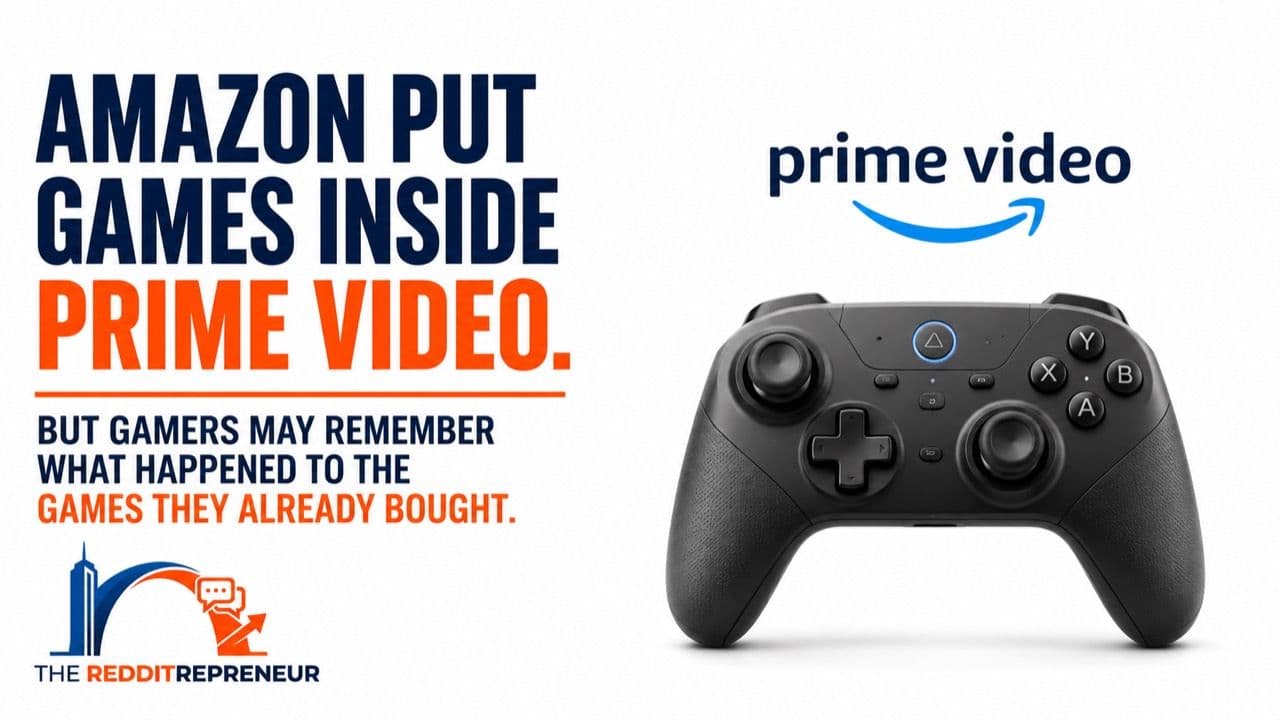
Amazon has made cloud gaming much easier to find.
But the new feature is not available everywhere.
On 23 July 2026, Amazon added a Games section to the Prime Video app on Fire TV devices.
The first rollout is for Prime members in the United States and the United Kingdom.
It is not yet a global launch.
Eligible members can choose a game and start playing without buying a console or downloading a large file.
The games are powered by Amazon Luna, the company’s cloud gaming service.
Players can use a compatible controller or turn their phone into a controller.
Amazon says it will share more details about other devices, countries and games in the coming months.
It sounds simple.
Open Prime Video.
Choose a game.
Start playing.
But Amazon still has another problem to solve.
Gamers need to trust that the games, progress and access they invest in will still be there later.
What Has Been Confirmed
Amazon officially launched Games inside Prime Video on Fire TV devices in the US and UK.
The section is available to Prime members in those two countries.
The game library shown as included with Prime does not require another Luna payment.
Luna Premium is a separate subscription with a wider library. Some games outside the Prime library require that extra plan.
A controller is not always required. Players can use a compatible controller or a phone. Some party games are designed around phone controls.
Amazon named Hogwarts Legacy, EA Sports FC 26, Indiana Jones and the Great Circle, Clue, Ticket to Ride, Taboo, Masters of the Universe: Legends Unite and Courtroom Chaos: Starring Arnold Schwarzenegger.
Amazon says more devices, countries and games will be announced.
What Amazon Has Changed
Amazon Luna used to feel like a separate product.
Many Prime members did not know it existed.
Others did not understand what was included with their membership.
Adding Amazon games inside Prime Video changes that.
Prime Video is already familiar.
People use it to watch films, television programmes and live sport.
Now Amazon wants it to become a place where people can play games too.
This solves a simple problem.
Amazon no longer needs people to search for Luna.
It can put the Prime gaming service in front of people who already use Prime Video.
Cloud Gaming in Simple Terms
Cloud gaming lets someone play a game over the internet.
The game runs on Amazon’s computers rather than on a console inside the person’s home.
The player sees the game on their television or another supported device.
Their controller sends commands over the internet.
This can remove the need to:
- Buy an expensive console.
- Build a gaming computer.
- Download a large game.
- Wait for updates.
- Find storage space.
That makes Amazon cloud gaming easier to try.
But it also means the player depends on Amazon.
Without a good internet connection and continued access to the service, the game may not work.
Amazon Has Solved the Discovery Problem
Luna’s first problem was awareness.
Many people simply did not know what it was.
Amazon already had:
- The technology.
- A large Prime membership.
- Fire TV devices.
- Popular games.
- A television app used by many people.
But Luna sat outside the main Prime Video experience.
Putting games inside Prime Video makes the service much easier to discover.
A person who opens the app to watch a programme may now notice the Games section and try something.
That is a strong distribution move.
Distribution simply means putting a product where people can easily find it.
What Is Included and What Costs More
Amazon says eligible Prime members can play the library shown as included with Prime at no extra cost.
The company has confirmed games such as Hogwarts Legacy, EA Sports FC 26 and Indiana Jones and the Great Circle.
It has also confirmed party games including Clue, Ticket to Ride and Taboo.
But the complete Luna service has more than one level.
Luna Premium offers a wider game library through a separate subscription.
That means not every Luna game is automatically included with Prime.
Amazon needs to show this difference clearly inside Prime Video.
People should know whether a game is:
- Included with Prime.
- Part of Luna Premium.
- Free to play.
- Likely to leave the library later.
Easier Access Does Not Automatically Create Trust
Amazon can make a game easy to open.
That does not mean players will trust the platform with hundreds of hours of their time.
Gamers may ask:
- Will this game still be here next month?
- What happens if it leaves the service?
- Will I lose my saved progress?
- Do I own anything?
- Can Amazon close the service?
- What happens if my subscription ends?
- Can I move my save to another platform?
- Will I need to pay more later?
These are not only technical questions.
They are customer trust questions.
Gamers Invest More Than Money
When someone watches a film through a subscription, they may spend two hours with it.
When someone plays a game, they may spend:
- Twenty hours.
- Fifty hours.
- One hundred hours.
- Several years.
They may also build:
- Saved game progress.
- Achievements.
- Online friendships.
- Competitive rankings.
- Custom characters.
- Emotional attachment.
This makes games different from most films and television programmes.
A game leaving a service can feel more serious because the player has invested part of their life in it.
Access and Ownership Are Not the Same
Amazon is offering access to games.
Access means someone can use something while it remains available through the service.
Digital game ownership means the person believes they can keep using a game they bought.
Those ideas are easy to confuse.
A Prime member may be able to play a game today.
That does not mean they own it.
The game may later leave the service.
Their Prime membership may end.
Amazon may change which games are included.
The publisher may remove the game.
The platform may change direction.
That does not automatically make the service bad.
Cloud gaming subscriptions often work this way.
But Amazon needs to explain the difference clearly.
What Happened to Earlier Luna Purchases
Amazon previously let people buy some individual games through Luna.
It also let players connect supported games from EA, GOG and Ubisoft through a feature called Bring Your Own Library.
On 10 April 2026, Amazon announced that these options were ending.
Individual purchases stopped.
Links to third party game stores stopped.
Ubisoft Plus and Jackbox subscriptions sold through Luna were also closed.
Previously purchased games remained playable on Luna until 10 June 2026.
After that date, Luna no longer streamed those affected games.
But Amazon did not delete every game a customer had bought.
The underlying purchases remained available through the linked EA, GOG or Ubisoft account.
Players could use those stores on a computer or another supported service.
What they lost was the ability to stream those games through Luna.
Refunds and Saved Progress Had Limits
Amazon did not offer a general refund for the affected purchases.
It said those sales were final unless its normal digital returns policy applied.
Some eligible customers were offered complimentary Luna Premium access.
Amazon also let affected players download save data for ninety days after 10 June.
But it gave an important warning.
A downloaded save might not work on another platform.
That decision belongs to the game publisher.
For games that remain on Luna, Amazon says progress is stored on the player’s Amazon account.
Cancelling a subscription does not itself delete that progress.
But saved progress is only useful if the player can still open the game somewhere.
Gamers Remember When Digital Access Disappears
The new Prime Video setup is different from the old Luna store.
It is mainly a subscription library.
But gaming communities may still remember that earlier streaming access did not last.
This can create a simple belief:
You never really own cloud games.
That belief may not describe every game, subscription or purchase correctly.
But it is easy to understand.
It is also easy to repeat.
One Simple Story Can Shape the Whole Product
The Redditrepreneur calls this Narrative Compression.
That means a complicated situation becomes one short and simple story.
For Luna, the story could become:
Amazon can take your games away.
That sentence may leave out important details.
It may ignore the difference between:
- Subscription games.
- Purchased games.
- Third party store connections.
- Rotating game libraries.
- Publisher licences.
But once the simple story spreads, it can affect how people judge the whole service.
Amazon then has to address the story, not only explain the details.
Amazon Is Trying to Change an Older Belief
The Redditrepreneur calls this Belief Correction.
That simply means people change what they believe about a company or product.
An earlier belief may have been:
Luna is a small service that Amazon may eventually close.
The new belief Amazon wants to create is:
Luna is becoming an important part of Prime.
Putting Prime Video Games in front of more people supports that new story.
But one product update may not be enough to remove older doubts.
Amazon needs to show long term commitment.
Former Cloud Gaming Users Have Good Reasons to Be Careful
Cloud gaming has been called the future for years.
Several companies have launched cloud gaming products.
Some changed direction.
Others closed.
Google Stadia is the clearest example.
Players bought games and invested time before Google shut it down.
Google refunded many hardware and game purchases.
But the closure still changed how people thought about cloud gaming ownership.
The lesson was simple.
Even a huge technology company can close a gaming service.
Amazon Luna trust is shaped by the history of the wider market, not only Amazon’s own choices.
This Is a Hype Hangover
The Redditrepreneur calls this a Hype Hangover.
A Hype Hangover happens when people were promised something exciting many times but were disappointed.
Cloud gaming has often been described as the future of gaming.
The promise was:
- No expensive console.
- No downloads.
- Play anywhere.
- Instant access.
- High quality games on basic devices.
Some of that promise is now real.
But the market also experienced:
- Slow responses caused by poor connections.
- Limited game libraries.
- Services closing.
- Games being removed.
- Confusing subscriptions.
That history makes gamers more careful.
Amazon is not introducing Luna to a completely fresh audience.
It is introducing Luna to people who may already have doubts about the whole idea.
Amazon May Not Need to Win Every Gamer
Amazon may not need to convince committed console and computer gamers to replace everything they already own.
The strongest early audience may be:
- Families.
- Casual players.
- People who cannot afford a new console.
- Prime members who rarely play games.
- Parents who want an easy option.
- People who want to try one game.
- Fans of Amazon programmes linked to games.
- People who value ease more than ownership.
For these users, opening a game inside Prime Video may feel good enough.
They may not care about building a permanent digital collection.
They may simply want quick entertainment.
That could still become a valuable market for Amazon.
Prime Video Is Becoming More Than a Video App
Prime Video now brings together:
- Films.
- Television.
- Live sport.
- Channels.
- Rentals.
- Purchases.
- Games.
Amazon is turning the app into an entertainment front door.
That means one place where customers can choose what they want to do.
This can make Prime feel more valuable.
It can also make the app more complicated.
Amazon must make sure people still understand:
- What is included.
- What costs extra.
- What requires Luna Premium.
- What may leave later.
- What works on their device.
Convenience disappears quickly when people become confused.
Trying a Game Is Not the Real Test
Amazon will probably be able to make people try games.
The Games section is easy to find.
The included titles are familiar.
People may be curious.
But the most important questions come later.
Amazon should measure:
- Do people come back?
- Do they finish games?
- Do they trust cloud saves?
- Do they pay for the higher plan?
- Do they recommend Luna?
- Do they believe the service will still exist in several years?
- Do they invest serious time in the platform?
Opening the Games section shows interest.
Returning for months shows trust.
What Amazon Should Do Next
Explain What Is Included
Customers should know which games come with Prime and which require Luna Premium.
Give Plenty of Notice
If a game is leaving, players should receive a clear and early warning.
Protect Saved Progress
Where possible, players should be able to keep or move their save data.
Explain What Happens When a Game Leaves
Customers should know whether they can continue elsewhere or transfer their progress.
Be Clear About Ownership
Amazon should clearly separate games included through a subscription from games connected to another store.
Show Long Term Commitment
Amazon should explain how Luna fits into its wider gaming plans.
This will help reduce the fear that Luna is only another short term experiment.
What Other Businesses Can Learn
This case applies beyond gaming.
It matters for:
- Streaming services.
- Software subscriptions.
- Digital books.
- Music.
- Online courses.
- Cloud storage.
- Virtual items.
- Membership platforms.
Businesses often focus on making access easy.
But customers also want certainty.
They want to know:
- What am I paying for?
- How long will I have access?
- Can the rules change?
- What happens to my work or progress?
- Can I take my data somewhere else?
- What do I actually own?
Easy access may win the first click.
Trust wins the long term customer.
The Main Lesson
Amazon has made Luna easier to discover.
That is important.
Prime Video already has a familiar audience.
Putting games inside the app removes a major barrier.
But discovery was only one of Luna’s problems.
Amazon must also convince gamers that the service is stable, clear and worth investing time in.
Gamers do not only ask whether they can play a game.
They also ask whether it will still be there later.
What This Means
- Amazon has made Luna much easier to find.
- Easy access does not mean players feel safe investing their time.
- Gamers care about saved progress and long term access, not only price.
- Amazon must clearly explain what players own and what may leave later.
Final Takeaway
Amazon has put games inside Prime Video for Prime members using Fire TV in the US and UK.
That could bring cloud gaming to people who never looked for Luna.
It makes gaming easier to find.
It makes gaming easier to start.
It may make Prime feel more valuable.
But Amazon still has to earn trust.
Players remember when digital services change direction.
They remember when games disappear from a service.
They remember when streaming access to purchases stops working.
Distribution can make a product easy to discover.
Only trust can make people comfortable building a long term relationship with it.
Community Intelligence Audit
Understand Whether Customers Trust Your Product Enough to Stay
Product data can show how many people opened the Games section.
It cannot always explain whether players trust the platform enough to stay.
The Redditrepreneur’s Community Intelligence Audit turns real customer conversations into clear insight about trust, ownership, product risk and long term adoption.
Community Intelligence means studying those conversations to understand what people believe and why.
Explore the Community Intelligence Audit Explore the Community Intelligence Platform