

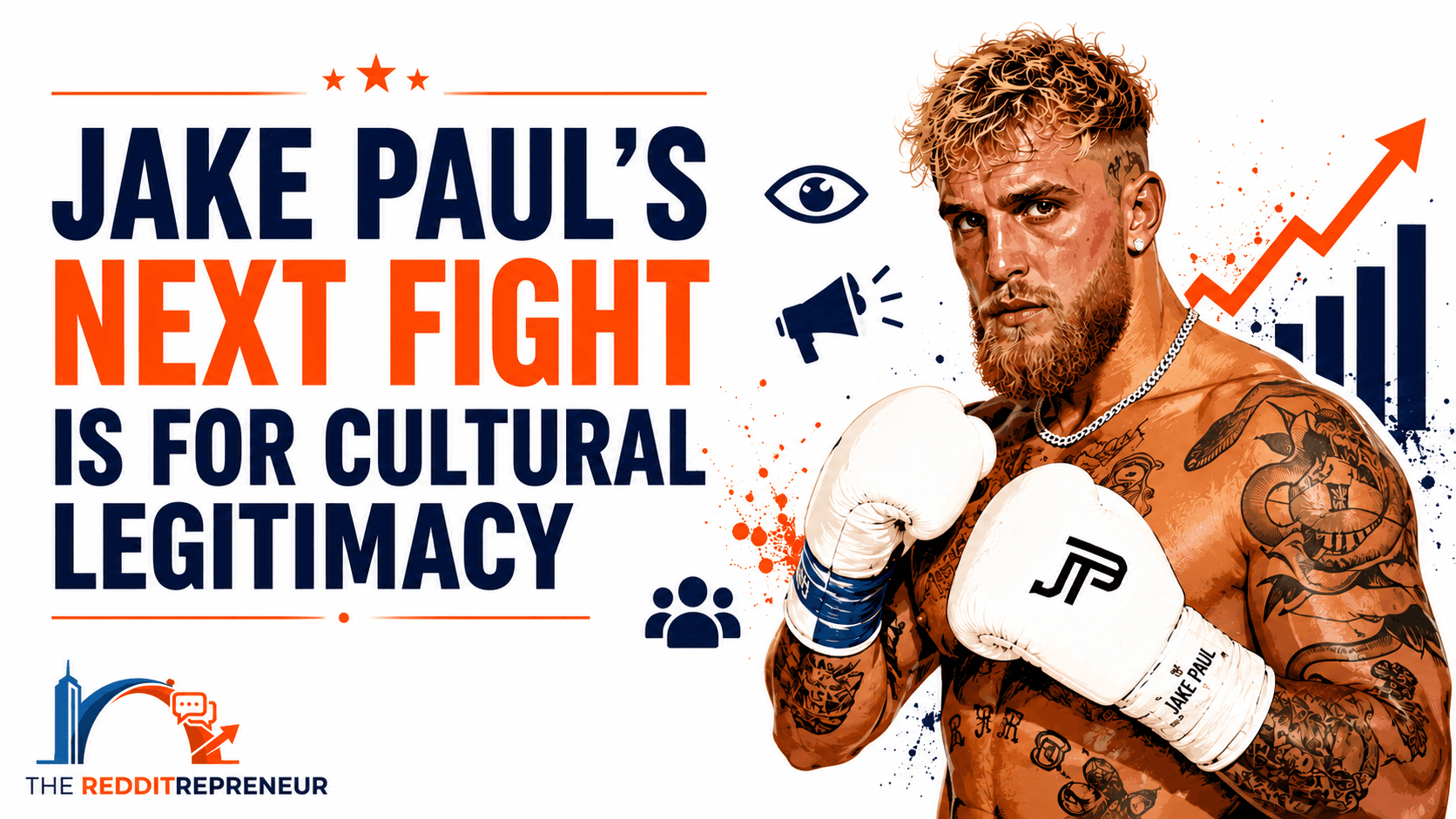
Jake Paul has already proved that an internet personality can sell a major boxing event.
He understands attention.
He understands controversy.
He understands how to make people talk.
Some people watch because they support him.
Others watch because they want to see him lose.
Either way, they watch.
That has helped Jake Paul move from YouTube into boxing, live events and sports promotion.
But his next challenge is much bigger.
He now needs to prove that attention can become something more permanent.
He needs to turn an audience into a trusted sporting institution.
Jake Paul’s next challenge is cultural legitimacy because he has already proved that his personal audience can sell fights. He must now show that this attention can create trust, support other fighters and build a sports organisation people care about when he is not competing.
This Is No Longer Only About Jake Paul Fighting
Jake Paul’s business interests now go beyond his own boxing matches.
Through Most Valuable Promotions, also known as MVP, he has helped promote other fighters and events.
Paul has also had a public partnership with the Professional Fighters League in mixed martial arts.
The wider ambition is not only to make Jake Paul famous.
It is to build a sports organisation that people care about even when Jake Paul is not competing.
That is much harder.
Millions of people may watch one famous person.
That does not mean they will automatically care about:
- A new fighter
- A wider roster
- A championship
- A full event card
- A promotion’s long-term future
Attention can be personal.
A successful sports organisation needs attention that can move beyond one person.
Jake Paul’s Biggest Asset Is His Audience
Traditional sports organisations usually begin with the competition.
They sign athletes.
They arrange events.
They find broadcasters.
They sell sponsorships.
Then they try to build an audience.
Jake Paul started in the opposite direction.
He built the audience first.
He already had:
- A recognisable identity
- Millions of followers
- Direct access to fans
- Experience creating online stories
- The ability to make an event feel important
He then used that attention to enter boxing.
This is Community Distribution Power.
Community Distribution Power
Community Distribution Power is the ability to direct an existing audience towards a new event, athlete, product or organisation.
Jake Paul can announce a fight and immediately create conversation.
A traditional promoter may need months of advertising to create the same level of awareness.
That is a serious business advantage.
But awareness is not the same as trust.
Attention Is Not the Same as Community
A large audience may watch something once.
A community keeps returning.
A sports community develops:
- Shared memories
- Favourite athletes
- Rivalries
- Traditions
- Arguments
- Predictions
- Jokes
- Reasons to care between events
Jake Paul has mastered attention.
The next test is whether he can create belonging.
This is Attention-to-Community Conversion.
Attention-to-Community Conversion
Attention-to-Community Conversion is the process of turning temporary interest into repeated participation and shared identity.
A viral moment may bring millions of views.
A lasting sports community needs people to return even when there is no major controversy.
They need to care about the organisation itself.
They need to recognise its fighters.
They need to understand its championships.
They need to know when events are happening.
They need reasons to follow the story over time.
Controversy Can Sell an Event
Jake Paul has often benefited from people strongly disagreeing with him.
This creates Adversarial Fandom.
Some viewers do not support Jake Paul.
They participate because they want him to fail.
They may:
- Watch the fight
- Discuss him online
- Share clips
- Argue about his ability
- Buy an event to see the result
This attention can still have commercial value.
However, it does not automatically create loyalty to the wider organisation.
Adversarial Fandom
Adversarial Fandom happens when people participate because they oppose a person, team or organisation.
They may produce views and revenue.
But they may disappear once the controversial person is no longer involved.
This creates a difficult question.
Will people who watch Jake Paul also watch an event built around fighters they do not already know?
That is the Audience Transfer Gap.
The Audience Transfer Gap
The Audience Transfer Gap is the difference between the number of people who follow a famous founder and the number willing to support the wider organisation.
Jake Paul’s personal audience is large.
The real test is whether that audience can be transferred to:
- Other fighters
- Women’s boxing
- Mixed martial arts
- Championship events
- Future sports properties
- An organisation that may one day operate without him at the centre
It remains to be seen how much of the audience will transfer.
If it does not, the business will remain dependent on Jake Paul.
One Personality Cannot Carry Everything Forever
Founder-led attention can help a company grow quickly.
It can also create Founder Attention Dependency.
This happens when a company struggles to remain culturally relevant without its founder being constantly visible.
For MVP to become a lasting sports institution, it will need to build stars beyond Jake Paul.
That means helping audiences understand:
- Who the fighters are
- Why their stories matter
- What they have overcome
- Who their rivals are
- Why people should follow their careers
A good athlete is not automatically a recognised athlete.
Sporting ability must be translated into a story that people understand.
This pattern also appears when trusted voices help football communities decide what matters.
Competitive Visibility Failure
Competitive Visibility Failure happens when talented athletes remain commercially invisible because their organisation has not explained why audiences should care.
A fighter may be excellent.
But many viewers will not follow them unless they understand:
- Their personality
- Their history
- Their goals
- Their rivalries
- Their importance to the sport
Jake Paul’s media experience could help solve this problem.
His strength has always been making a simple story easy to understand.
Sports Value Begins Before the Event
A fight is not valuable only when the first punch is thrown.
Value begins earlier.
It develops through:
- Predictions
- Interviews
- Training footage
- Arguments
- Press conferences
- Rivalries
- Fan discussions
- Clips
- Memes
- The feeling that something important is approaching
This is Pre-Event Community Value.
Pre-Event Community Value
Pre-Event Community Value is the attention, emotion and discussion created before a sporting event begins.
The strongest sports organisations do not only sell the event.
They sell the anticipation.
Fans want to debate who will win.
They want to choose sides.
They want to understand the story.
They want to feel that the result matters.
Jake Paul understands this very well.
The harder challenge is creating the same feeling for athletes who do not already have his audience.
Cultural Legitimacy and Sporting Legitimacy Are Different
A modern sports organisation needs two types of acceptance.
It needs Sporting Legitimacy.
This comes from:
- Fair competition
- Skilled athletes
- Clear rules
- Meaningful championships
- Credible matchmaking
- Respect from serious fans
It also needs Cultural Legitimacy.
This comes from:
- Public attention
- Recognisable personalities
- Online conversation
- Media relevance
- Memorable stories
- The ability to reach casual audiences
Jake Paul already has strong cultural relevance.
His next challenge is proving that his organisation also deserves sporting respect.
This is Dual Legitimacy.
Dual Legitimacy
Dual Legitimacy is the need for a sports organisation to earn trust from serious fans while also remaining interesting to a wider cultural audience.
Too much entertainment can damage sporting credibility.
Too much complexity can make the sport difficult for casual viewers to understand.
A successful organisation must balance both.
It needs serious competition.
It also needs stories that ordinary people can follow.
Community Intelligence Can Identify Which Fighters Matter
Traditional sports data can show:
- Wins
- Losses
- Rankings
- Viewing figures
- Ticket sales
- Social followers
Community Intelligence can reveal:
- Which fighters fans are beginning to care about
- Which rivalries feel genuine
- Which stories people repeat
- Which athletes attract support beyond their results
- Which audiences feel ignored
- Why viewers do not return
- Which event formats confuse people
- Which criticism represents a real trust problem
This intelligence can help a promotion decide where to invest attention.
Fighter Community Equity
Fighter Community Equity is the strength and commercial value of the community surrounding an athlete.
It includes more than follower numbers.
A fighter may have fewer followers but a highly committed community.
Their fans may:
- Buy tickets
- Watch every event
- Defend them online
- Share their interviews
- Follow their full career
- Purchase merchandise
- Introduce other people to the sport
That loyalty can be more valuable than a large but passive following.
The Promotion Must Build Community Continuity
Large events create short periods of intense attention.
A lasting sports organisation needs people to remain interested between those events.
This requires Community Continuity Infrastructure.
Community Continuity Infrastructure
Community Continuity Infrastructure is the set of repeated activities that keeps a fan community active between major events.
It can include:
- A predictable event calendar
- Rankings people understand
- Regular fighter interviews
- Community content
- Documentaries
- Behind-the-scenes access
- Press conferences
- Recurring programmes
- Clear championship paths
- Fan discussions
Without this structure, attention can disappear after each event.
Every new event then has to rebuild interest from the beginning.
Shared history matters too. Our analysis of the Community Memory Advantage explains how repeated experiences can make a platform feel familiar and important.
Community-Led Matchmaking Can Reveal Demand
Rankings and sporting merit should remain important.
But community conversation can reveal which contests people genuinely care about.
Fans may already be:
- Comparing two athletes
- Arguing over their strengths
- Sharing old clips
- Building a rivalry
- Asking repeatedly for the same fight
This is Community-Led Matchmaking.
Community-Led Matchmaking
Community-Led Matchmaking uses fan conversations and emotional demand to help identify contests people want to see.
It should not replace fair sporting rules.
It can support them by revealing demand that viewing data or rankings may miss.
The strongest contest may combine:
- Sporting merit
- A clear story
- Genuine community interest
- Emotional importance
The Biggest Challenge Is Trust
Jake Paul’s ability to attract attention is already proven.
The deeper question is whether fans trust the organisation he is building.
Trust will depend on:
- How fighters are treated
- Whether events are well organised
- Whether championships feel meaningful
- Whether matchmaking feels fair
- Whether promises about fighter opportunity are kept
- Whether the organisation can survive beyond one personality
- Whether fans feel respected rather than simply monetised
Cultural legitimacy cannot be bought through attention alone.
It must be earned through repeated behaviour.
The same distinction between attention and lasting trust appears in our analysis of commercial pressure around the World Cup.
The Community Intelligence Lesson
Jake Paul has shown that audience ownership can become sports infrastructure.
His audience can create awareness.
It can attract broadcasters.
It can sell tickets.
It can create sponsorship value.
It can make an event culturally visible.
But his next fight is not simply against another boxer.
It is the fight to prove that creator attention can become a lasting institution.
The question is no longer:
“Can Jake Paul make people watch?”
He has already answered that.
The new question is:
“Can he make people care about the sport when he is no longer the main event?”
Community Intelligence Frameworks
Community Distribution Power
The ability to direct an existing audience towards a new event, athlete, product or organisation.
Attention-to-Community Conversion
Turning temporary interest into repeated participation, loyalty and shared identity.
Adversarial Fandom
Commercial attention created by people who participate because they want someone to fail.
Audience Transfer Gap
The difference between a founder’s personal audience and the audience willing to support the wider organisation.
Founder Attention Dependency
When an organisation depends too heavily on one person to remain relevant.
Competitive Visibility Failure
When talented athletes remain unknown because their stories have not been communicated well.
Pre-Event Community Value
The attention, anticipation and discussion created before an event begins.
Dual Legitimacy
The need to earn both sporting credibility and wider cultural relevance.
Fighter Community Equity
The strength and commercial value of the community surrounding an athlete.
Community Continuity Infrastructure
The schedules, stories and rituals that keep fans active between events.
Community-Led Matchmaking
Using genuine fan demand to help identify meaningful contests without replacing sporting merit.
Institutional Community Memory
The history, rivalries and shared moments that give a sports organisation long-term meaning.
What This Means
- Jake Paul’s biggest business advantage is his direct access to an audience.
- A large audience does not automatically become a loyal sports community.
- MVP must make people care about fighters beyond Jake Paul.
- Controversy can sell events without building long-term trust.
- Cultural legitimacy and sporting legitimacy must be developed together.
- Community Intelligence can identify emerging fighters, rivalries and fan concerns.
- The real test is whether the organisation remains relevant when Jake Paul is not competing.
Understand What Your Fans Really Care About
Viewing figures tell you how many people watched. Community Intelligence explains which athletes mattered, why fans cared and whether they are likely to return.
Book a Community Intelligence Audit Explore The Redditrepreneur