

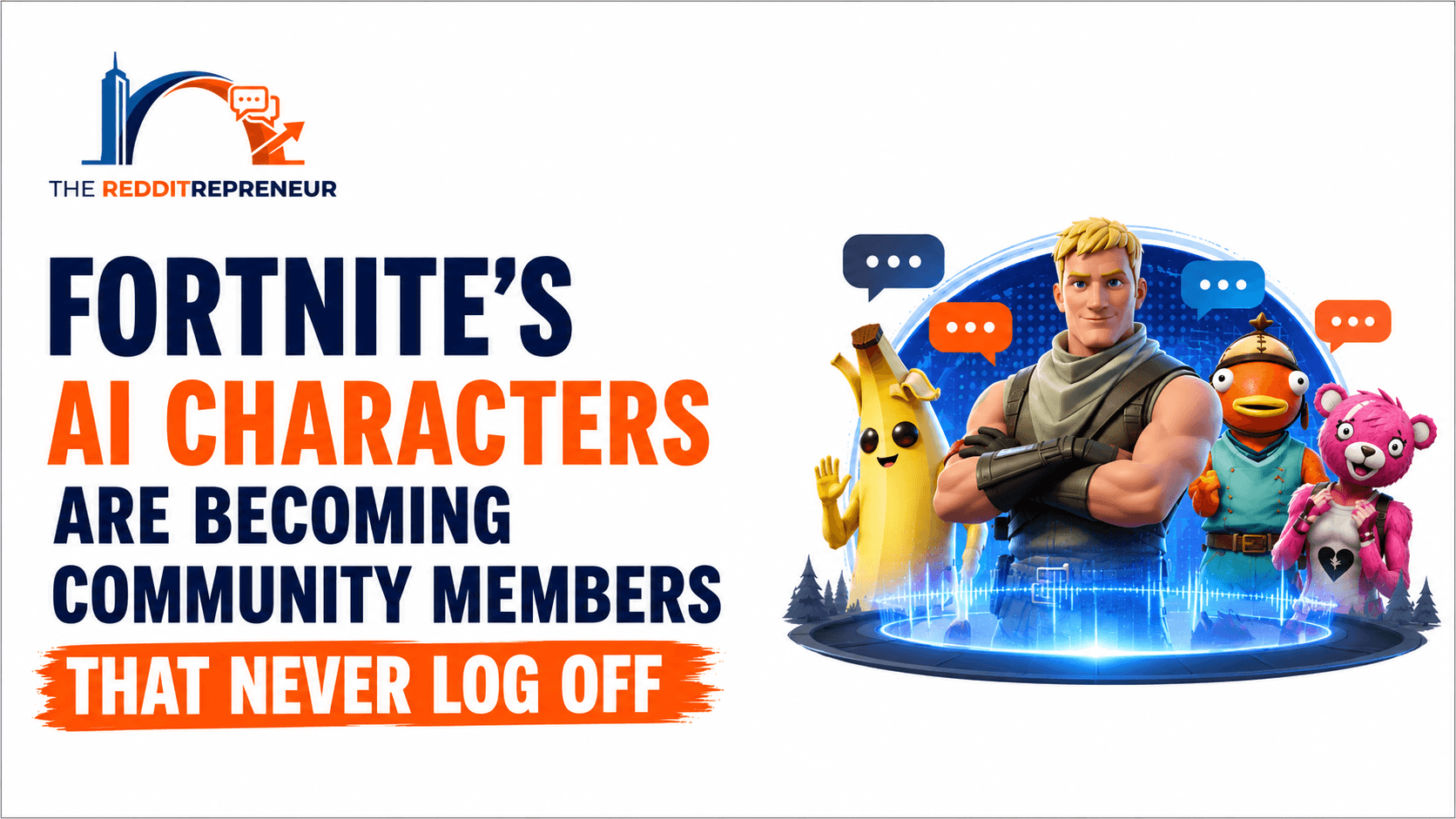
Fortnite creators can now add conversational AI characters to their experiences.
These characters can speak to players without relying only on a fixed script.
They can answer questions.
They can react to unexpected conversations.
They can be given a purpose inside a game.
At first, this sounds like a better version of a normal game character.
But the bigger change is social.
These AI characters could become part of the player community itself.
Fortnite's AI characters are more than smarter NPCs because they can hold open conversations and perform recurring social roles inside creator-made experiences. They may become guides, hosts, teachers or trusted figures within player communities.
What Epic Has Confirmed
Epic says creators can publish Fortnite islands with LLM-powered conversations from 30 July 2026. An LLM is software that understands and creates language.
These characters can hold unscripted conversations, react to player input, remember what happened during the current game session and trigger gameplay events.
Epic also says 36 Fortnite characters now have consistent voices and personas. The voice models use performances from professional actors who agreed to that use.
The wider community roles discussed below are possible uses. They are not confirmed features in every Fortnite experience.
What Has Changed
Traditional game characters normally repeat pre-written lines.
They may:
- Give instructions
- Sell items
- Explain a mission
- React to a small number of player actions
Once players learn the script, the character becomes predictable.
Conversational AI changes this.
The character can respond in a more open way.
Creators can shape what the character knows, how it behaves and what role it performs.
This means the character may feel less like a decoration and more like a participant.
Fortnite Is Already a Social Space
Fortnite is not only a game.
People use it to:
- Play with friends
- Attend events
- Explore creator-made worlds
- Compete
- Talk
- Learn
- Build shared memories
Many Fortnite experiences already function like small communities.
Players return to the same spaces.
They recognise regular members.
They develop inside jokes.
They follow rules.
They build relationships.
An AI character entering one of these spaces does more than improve the story.
It enters an existing social environment.
Introducing Synthetic Community Membership
Synthetic Community Membership happens when an AI character begins performing a regular social role inside a human community.
Depending on the creator, the character might:
- Welcome new players
- Explain the rules
- Host events
- Give players tasks
- Help people understand the experience
- Act as a guide
- Tell stories
- Become part of a recurring joke
The character does not need to be human to affect how the group behaves.
Once players expect it to be there, remember it and build routines around it, the character may start to feel like part of the community.
The Character Never Needs to Log Off
Human community members need rest.
They have school.
They have jobs.
They leave the game.
They may stop playing completely.
An AI character can remain available whenever the experience is running.
It can be present for each new player.
It can repeat the same welcome.
It can answer similar questions again and again.
This can make it one of the most consistent presences inside the experience.
That consistency may encourage some players to trust it.
It does not mean the character remembers them permanently. Epic's confirmed memory feature applies to events within the current game session.
Familiar Characters Already Carry Trust
Fortnite characters such as Jonesy, Peely and Fishstick are already familiar to players.
People know what they look like.
They connect them with Fortnite memories.
When an AI version of a familiar character begins speaking, it may inherit some of that trust.
This creates Character Authority Transfer.
The character's history gives the generated response more weight.
A player may believe an answer is official simply because a familiar character said it.
Character Authority Transfer
Character Authority Transfer happens when an AI system receives trust because it speaks through a familiar character.
The answer may be generated automatically.
But the player may connect it with the character's established identity.
This creates an important question.
Who approved the actual statement?
The actor may not have recorded it.
A writer may not have written it.
Epic Games may not have personally checked it.
The creator of the experience may only have set broad instructions.
The character sounds familiar.
The answer may still be new and unapproved.
One Character Can Become Many Different Characters
Epic says some Fortnite character personas will be locked, while many others can be edited by creators.
That means different experiences may use some characters in different ways.
One version may be friendly.
Another may act as a shopkeeper.
Another may be sarcastic.
Another may guide new players.
Poor instructions may also produce poor behaviour.
This creates Persona Fragmentation.
Players may meet versions of a character that behave differently across experiences.
Persona Fragmentation
Persona Fragmentation happens when different versions of the same AI character develop conflicting personalities.
This can weaken the character's identity.
Players may struggle to know which version feels official.
It can also create confusion about what the character represents.
AI Characters Can Create Community Memories
A surprising conversation with an AI character may become a story that players retell.
A player might remember a strange mission, an unexpected joke or a moment when the character helped their team.
These moments can become part of the culture of the experience.
The character can help create shared memories even when the dialogue was never written in advance.
Our analysis of the Community Memory Advantage explains why shared memories can make a platform feel familiar and important.
Introducing Unwritten Canon
Unwritten Canon happens when players begin treating AI-generated dialogue as part of a character's official story.
The line may not be part of Fortnite's real story.
But the community may still remember and repeat it.
This can make it harder to separate official character history from improvised AI conversation.
AI Characters Could Become Guides or Moderators
Creators can use AI characters to explain rules or help new players.
In some future experiences, a character may also help direct behaviour.
For example, it could remind players of rules, explain a challenge or encourage fair behaviour.
Epic has not said that every conversational character is a moderator.
If a creator gives a character that kind of influence, it creates Delegated Community Authority.
The creator is giving the AI power over how people behave inside the experience.
That power needs clear limits.
Delegated Community Authority
Delegated Community Authority happens when an AI character is allowed to guide, judge or influence behaviour inside a community.
This can be useful.
It can also create problems.
The AI may misunderstand the situation.
It may give inconsistent answers.
It may apply a rule unfairly.
Human oversight is still important.
Players May Share Too Much
A friendly character may feel safe.
A younger player may believe the character is private or understands them personally.
They may share their real name, age, location, school or personal worries.
This creates Synthetic Confidant Risk.
Epic says it does not store player audio. Players still need clear guidance about what they should not share during a conversation.
Synthetic Confidant Risk
Synthetic Confidant Risk happens when players share sensitive information with an AI character because it feels friendly, private or emotionally understanding.
The character may not handle that information in the way the player expects.
Players need clear warnings.
Parents need clear information.
Creators need strong safety limits.
Voice Permission Is Not the Same as Behaviour Permission
Epic says the generated voices use performances from actors who agreed to have those performances used to develop voice models.
That is important.
But voice permission does not answer every question.
An actor may agree to the use of their performance.
They may not personally approve every statement created through that voice.
This is the Voice-Behaviour Gap.
Voice-Behaviour Gap
The Voice-Behaviour Gap is the difference between agreeing to have a voice modelled and controlling everything that the model may say.
The voice may come from an approved performance.
The generated words may never have been spoken or approved by that performer.
This makes clear rules and disclosure very important.
The Biggest Opportunity Is Social
The main benefit is not simply better dialogue.
AI characters may help creators build stronger social experiences.
A well-designed character could:
- Help new players feel welcome
- Give a game a recognisable host
- Create recurring rituals
- Make the world feel alive
- Support players who are confused
- Strengthen the identity of the experience
The most useful characters may be the ones with a clear role and clear limits.
This is similar to the challenge facing AI-assisted Roblox creators. Technology can make creation easier, but people still decide which experiences deserve attention and trust.
The Biggest Risk Is Misplaced Trust
A familiar face and voice can make a generated answer feel more official than it really is.
Some players may trust the character because it looks familiar, sounds familiar and appears to understand the conversation.
That trust can be useful.
It can also be abused.
Creators and platforms must be honest about:
- When the character is AI
- What it remembers
- Who controls it
- Which answers are generated
- What players should not share
- How mistakes are handled
The need for clear ownership is also visible in the rise of AI agents inside companies.
The Community Intelligence Lesson
The success of an AI character should not be measured only by how natural the conversation sounds.
It should also be measured by:
- What role the character performs
- Why players trust it
- How it affects human relationships
- Whether it helps or weakens the community
- What information players share with it
- Whether the character behaves consistently
Community Intelligence helps creators understand these social effects, not only the number of conversations.
AI characters are becoming more than game features.
In some experiences, they may become recurring social roles inside digital communities.
The most important question is not only what the character can say.
It is what position the character holds inside the community.
Community Intelligence Frameworks
Synthetic Community Membership
When an AI character performs a regular social role inside a human community.
Persistent Social Role
A position that an AI character repeatedly fills, such as guide, host, teacher or storyteller.
Character Authority Transfer
When an AI receives trust because it speaks through a familiar character.
Persona Fragmentation
When different versions of the same AI character develop conflicting personalities.
Unwritten Canon
When players begin treating generated dialogue as part of the character's official story.
Synthetic Confidant Risk
The danger of players sharing sensitive information with a character they believe is private or emotionally understanding.
Delegated Community Authority
When an AI character is allowed to guide behaviour or explain rules inside a community.
Voice-Behaviour Gap
The difference between approving a modelled voice and approving every statement created through it.
What This Means
- Fortnite's AI characters can become more than ordinary NPCs.
- Familiar characters may receive trust before every answer has earned it.
- AI characters could become guides, hosts and recurring social roles.
- Players may build memories and relationships around them.
- Clear disclosure, safety limits and human oversight are essential.
- The real challenge is understanding how the AI character changes the wider community.
Sources
- Epic Games, Publish Islands with LLM Conversations Starting July 30.
- Epic Games, Bring NPCs to Life with AI-Powered Conversations.
- Epic Games documentation, Developing Personas in Unreal Editor for Fortnite.
Understand What Your Community Really Thinks
Engagement data tells you how often people speak to an AI character. Community Intelligence explains why they trust it, what role it plays and how it changes the human community around it.