
Nike is one of the most recognised brands in the world.
Its influence extends beyond footwear and clothing into sport, fashion, identity, aspiration and popular culture.
That scale makes conventional brand measurement useful, but incomplete.
Revenue can show what customers purchased. Awareness can show whether people recognise the name. Sentiment can show whether mentions appear positive or negative.
None of those measures fully answers a more important question.
What are customers, prospects and communities actually saying when the brand is not in the room?
That is the purpose of Community Intelligence.
This editorial Scorecard examines the beliefs, recommendations, comparisons and recurring narratives surrounding Nike. It focuses on the public evidence that influences trust, choice, reputation and AI search visibility.
Executive Summary
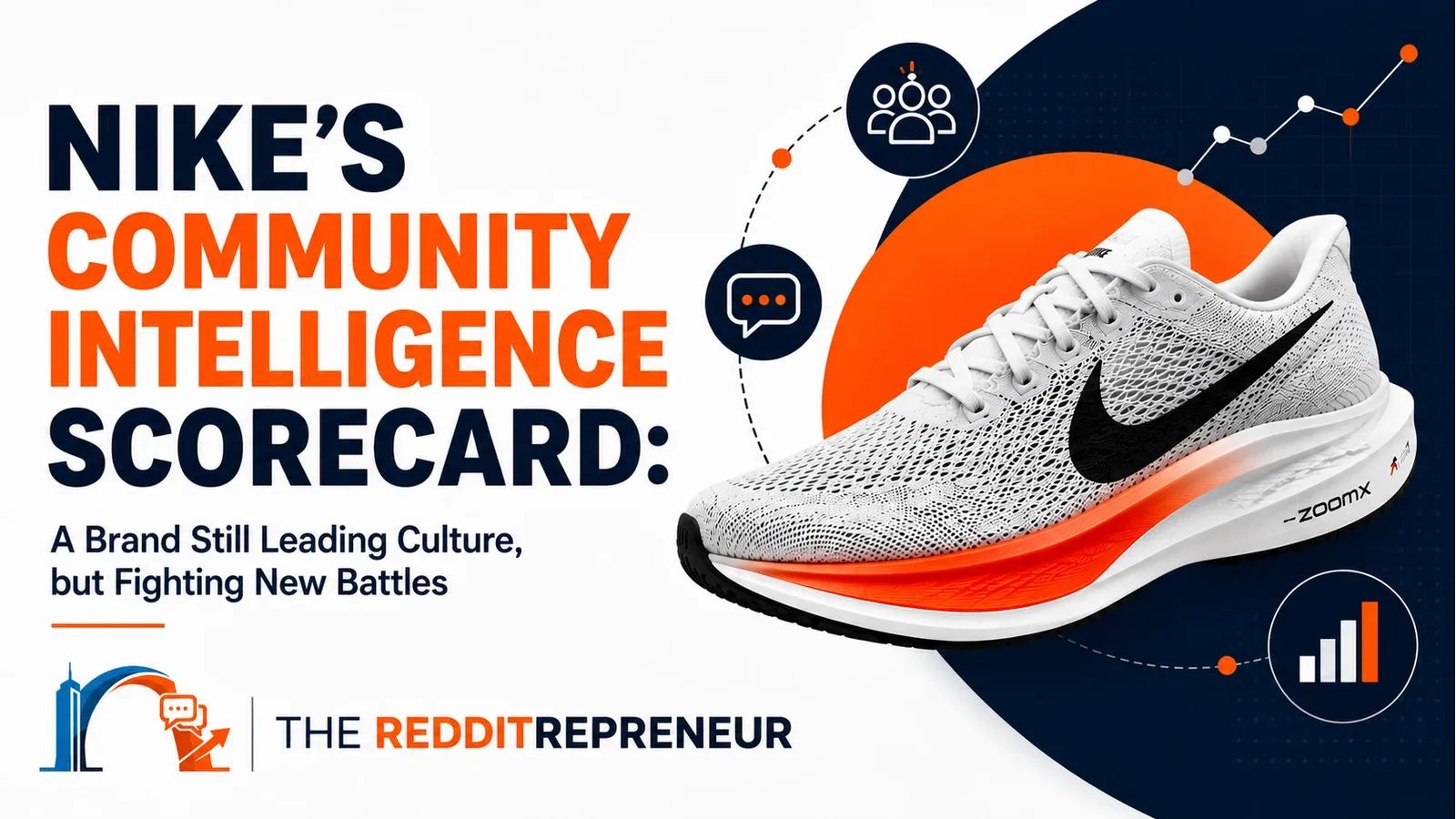
Nike receives an overall Community Intelligence Score of 84 / 100, with an Excellent rating.
The result reflects a brand with exceptional cultural reach, durable trust and a remarkable ability to remain present inside conversations that matter.
Nike has not lost its position as a defining force in sport and culture. Its name still carries immediate meaning. Customers continue to recommend familiar products. Fans defend the brand. Athletes, collectors and casual buyers all contribute to a public evidence layer that very few competitors can match.
The central challenge is more specific.
Nike now competes in a market where specialist running brands have built clear identities around comfort, performance, design and distinct product experiences. HOKA, On, New Balance and adidas create credible alternatives within conversations that once might have defaulted more easily to Nike.
This does not amount to a collapse in trust.
It is evidence of a more competitive conversation.
Nike remains culturally dominant, but customers have more reasons to compare. Running communities frequently discuss fit, cushioning, stability, durability, price and intended use before arriving at a recommendation. Brand recognition opens the consideration set. Product evidence increasingly decides the outcome.
The strongest strategic opportunity is therefore not simply to become louder.
It is to make Nike's current performance story easier for communities to recognise, explain and recommend.
Nike Community Intelligence Scorecard
| Measure | Score | Interpretation |
|---|---|---|
| Brand Trust | 9.2 / 10 | Durable confidence supported by familiarity, history and product experience. |
| Product Satisfaction | 8.1 / 10 | Positive overall, with meaningful variation by model, fit and intended use. |
| Innovation Perception | 7.6 / 10 | Strong heritage and active development, with greater specialist competition for attention. |
| Customer Support | 7.2 / 10 | The clearest opportunity for a more consistently reassuring experience. |
| Community Engagement | 9.1 / 10 | Exceptional natural presence across sport, fashion, running and culture. |
| Competitive Position | 8.5 / 10 | A category leader facing stronger alternatives in specialist performance segments. |
| Advocacy | 9.0 / 10 | Customers and fans continue to recommend, defend and identify with the brand. |
| AI Search Readiness | 9.3 / 10 | A rich public evidence base gives AI systems extensive material to interpret. |
| Narrative Consistency | 7.8 / 10 | A powerful core identity with more varied product narratives across distinct communities. |
Overall result
84 / 100
Rating: Excellent
Nike remains a brand with outstanding Community Gravity. The next contest is not basic recognition. It is maintaining specialist product authority while communities gain more credible choices.
Nike Is Not Losing Trust. It Is Facing Better Competition.
The most important finding is easy to misunderstand.
More comparisons do not necessarily mean less trust.
In many public running conversations, Nike remains a respected and familiar option. People recommend particular models, discuss previous experiences and recognise the company's history of performance innovation.
At the same time, recommendations have become more conditional.
A customer may prefer HOKA for a particular cushioning experience. Another may choose On for design or feel. A runner may favour New Balance because a specific model suits their foot shape. adidas may enter the conversation through performance credibility, price or personal experience.
The decision is increasingly framed around the job the shoe must perform.
That is a sign of category maturity and credible competition.
Nike can remain trusted while losing some automatic recommendations. It can remain culturally important while facing stronger product comparison. It can remain innovative while other brands become more visible as innovation stories.
The strategic question is therefore not whether communities still care about Nike.
They clearly do.
The question is whether Nike gives those communities enough current, specific and repeatable evidence to explain why a particular Nike product is the right choice now.
Community Gravity
Community Gravity describes the force that pulls people towards a brand, topic or shared identity and keeps the conversation active.
Nike has exceptional Community Gravity.
The brand can enter a conversation through elite sport, everyday exercise, streetwear, collecting, design, nostalgia or personal identity. A single product release can attract runners, fashion communities, athletes, reviewers and casual consumers for different reasons.
This breadth is difficult to reproduce.
It means Nike benefits from more than attention. It benefits from cultural memory.
People do not encounter the brand as a blank page. They bring previous purchases, famous campaigns, sporting moments, personal milestones and established beliefs into every new discussion.
That creates a powerful advantage for launches and recommendations. It also creates a demanding standard.
When communities expect Nike to lead, ordinary progress may attract less excitement than similar progress from a smaller challenger. The brand is often judged against its own history as much as against a competitor.
Community Gravity therefore creates both reach and pressure.
Nike's task is to turn enormous cultural attention into clear product understanding. The conversation is already present. The opportunity is to make its most useful evidence easier to carry from one community member to another.
Innovation Perception
Nike remains strongly associated with innovation.
Its official running communications continue to present active work across racing, daily running and trail products. That owned evidence supports the view that product development remains central to the company.
However, innovation perception is not created by company announcements alone.
It is created when communities experience a meaningful difference and repeat a simple explanation for it.
This is where the competitive environment has changed.
HOKA has built a recognisable position around cushioning and a distinctive running experience. On has achieved visibility through design, technology language and a clear visual identity. New Balance frequently enters discussions through fit, comfort and a broad performance range. adidas retains deep sporting credibility and visible running innovation.
Nike still has the research capability, athlete relationships and product range to lead. The challenge is narrative clarity.
A community member should be able to explain not only that Nike innovates, but what a current innovation changes for a particular runner.
Specific evidence is more persuasive than a general reputation.
Innovation perception improves when a product promise, lived experience and community explanation all reinforce one another.
Brand Trust
Nike's Brand Trust score is one of the strongest parts of the assessment.
Trust and satisfaction are related, but they are not identical.
A customer can trust Nike as a serious sporting brand while deciding that a particular shoe does not fit well. A runner can respect the company while preferring a competitor for a specific training need. A fan can remain loyal while questioning a release, price or service experience.
This distinction matters because simplistic sentiment analysis can treat every criticism as evidence of declining trust.
Community Intelligence looks at the belief underneath the comment.
Does the person doubt the entire brand, or are they describing a specific experience?
Does comparison remove Nike from consideration, or does it show that customers are making a more informed choice?
Does a complaint lead to rejection, or does the customer still expect Nike to resolve it because trust remains?
Nike's public evidence suggests a brand with substantial reserves of trust. That reserve should not be treated as permanent. Consistent product delivery and customer support remain essential to protecting it.
Narrative Consistency
Nike has one of the clearest corporate identities in the world.
The wider product narrative is more complex.
A lifestyle customer, a collector, a new runner and an experienced athlete may each describe Nike differently. That breadth is a commercial strength, but it can make the most important current performance story harder to compress.
Narrative Compression explains how communities reduce complexity into a simple, portable belief.
Competitors can benefit when their compressed narrative is easier to repeat.
A clear association with comfort, speed, fit or design can travel quickly through recommendation threads. Nike's larger portfolio creates more possible stories and therefore more competition within its own narrative.
The opportunity is not to reduce Nike to one message.
It is to ensure that each important product has a precise community explanation attached to it.
AI Search Readiness
Nike receives the highest individual score for AI Search Readiness.
The reason is evidence.
Nike has a vast combination of owned evidence, institutional evidence and community evidence. Its products are documented, reviewed, compared, discussed and recommended across a wide range of public sources.
As explained in The AI Evidence Layer, visibility on a single platform is less important than the quality and consistency of the wider evidence surrounding a brand.
Nike's scale gives AI systems many signals to interpret.
Scale alone does not guarantee a favourable recommendation.
An AI system may encounter positive running experiences, product criticism, specialist comparisons and changing category preferences. The resulting answer can depend on the question, available sources and product context.
That is why Community Intelligence matters for AI search.
It helps a brand understand the evidence that exists beyond its own website, identify gaps and recognise which competitor narratives are becoming easier for both people and machines to repeat.
Community Intelligence Frameworks
Frameworks help explain movement inside a conversation. They should clarify the evidence rather than force every observation into a predetermined story.
Community Gravity
This is the clearest framework for Nike. The brand attracts participation across several connected communities and carries deep cultural memory. That gravity creates exceptional reach, advocacy and resilience.
Narrative Compression
This framework is also relevant. Specialist competitors can benefit from simple product associations, while Nike's breadth creates several simultaneous narratives. Clearer product explanations can help communities carry Nike's current innovation story.
Belief Correction
Belief Correction may occur when repeated product evidence changes an established view. For Nike, a sequence of strongly recommended releases could strengthen the belief that the company is setting the pace in a specialist segment. The available evidence does not support claiming that a complete correction has already occurred.
Trust Collapse
Trust Collapse does not describe Nike's current position. The brand continues to hold strong confidence and advocacy. The framework remains useful as a reminder that trust can weaken when repeated experience consistently contradicts expectation.
Hype Hangover
Hype Hangover can apply to an individual launch when anticipation rises beyond the experience delivered. It should not be used as a general description of Nike. Product level analysis is more accurate than applying one verdict to the whole brand.
Strategic Opportunities
Make product evidence easier to understand
Communities recommend products when they can explain the fit between a need and an experience. Nike can strengthen advocacy by making the intended user, use case and practical benefit of each important model unmistakably clear.
Treat comparison as research
Conversations that compare Nike with HOKA, On, New Balance and adidas contain valuable decision criteria. They reveal the language customers use, the trade offs they accept and the evidence that moves a recommendation.
Connect innovation with lived experience
Official product development creates owned evidence. Customer explanation creates community evidence. The strongest innovation narrative appears when both tell the same story.
Protect trust through customer support
Customer Support is the lowest score in this assessment. A trusted brand should make problem resolution feel consistent with the confidence created before purchase. Clear ownership, useful communication and visible learning can prevent isolated frustration from becoming a wider narrative.
Measure narrative movement
Brand teams should track more than positive and negative mentions. They should monitor which beliefs are growing, which competitor stories are becoming easier to repeat and where recommendation language is changing.
Build for AI interpretation
Nike already has extraordinary evidence volume. The next opportunity is evidence clarity. Structured product information, credible independent recognition and consistent community experience can make the brand easier to represent accurately in AI generated answers.
Why This Matters
Nike demonstrates why Community Intelligence is more useful than a simple popularity measure.
A famous brand can remain trusted while facing more competitive recommendations. It can possess enormous Community Gravity while needing clearer specialist product stories. It can have excellent AI search readiness while still encountering mixed evidence about individual products and experiences.
These are not contradictions.
They are the reality of a complex brand operating across many communities.
The strategic value comes from identifying where belief is stable, where it is moving and what evidence is driving the change.
How This Score Was Calculated
This editorial Scorecard assesses Nike across nine measures supplied for this report: Brand Trust, Product Satisfaction, Innovation Perception, Customer Support, Community Engagement, Competitive Position, Advocacy, AI Search Readiness and Narrative Consistency.
The assessment interprets recurring themes in public product discussion, recommendation behaviour, brand evidence and competitor comparison. It also considers current owned evidence from Nike's official running communications and the wider public record surrounding the brand.
Public comparison threads are treated as qualitative illustrations of language and decision criteria. They are not presented as a representative sample of all Nike customers.
The scores are strategic editorial judgements. They are not customer review ratings, live software outputs or statistically representative survey results.
Read The Redditrepreneur Community Intelligence Scorecard methodology for the wider assessment approach.
Limitations: Public conversations do not represent every customer, market or product. Available evidence varies by community and can change over time. This report does not claim a fixed sample size, complete market coverage or access to private company data.
Frequently Asked Questions
What is Nike's Community Intelligence Score?
Nike receives an editorial Community Intelligence Score of 84 out of 100, with an Excellent rating.
What is the main finding of the Nike Scorecard?
Nike retains high trust, advocacy and cultural authority. Its main challenge is stronger competition from brands with clear specialist performance stories.
Is this an automated customer rating?
No. This is an editorial Community Intelligence assessment produced by The Redditrepreneur. It is not an automated live SaaS score or a statistically representative customer survey.
Why is Nike strong in AI search readiness?
Nike has extensive owned, institutional and community evidence across products, sport, culture and customer experience. That gives AI systems a broad public evidence base to interpret.
Editor's Note
This Scorecard represents an evidence led assessment based on publicly available community conversations, reviews, discussion forums, editorial sources and public brand signals.
It is intended to demonstrate the Community Intelligence Scorecard methodology rather than provide a definitive assessment of Nike.
The Redditrepreneur produces Community Intelligence research to help organisations understand what online communities say about their brand, competitors and market.
This Scorecard should be read as a transparent editorial interpretation of public evidence. It does not claim official endorsement by Nike and does not replace customer research, market data or direct operational analysis.
Conclusion
Nike remains one of the strongest community brands in the world.
Its trust is high. Its advocacy is powerful. Its Community Gravity is exceptional. Its public evidence gives it outstanding AI search readiness.
The new battle is not basic relevance.
It is making current product leadership as easy to understand and repeat as the wider Nike identity.
Nike is not losing trust.
It is facing better competition.
The brands that learn fastest from that conversation will shape what communities recommend next.
Nike remains one of the world's strongest brands.
But the brands that continue leading tomorrow will be the ones that understand community conversations today.
Community Intelligence Audit
See What Your Customers Are Really Saying
Every business has a Community Intelligence Score, whether they measure it or not. Book a Community Intelligence Audit to discover what your customers, prospects and competitors are really saying across Reddit, reviews, YouTube, forums and other online communities.
Book a Community Intelligence Audit