

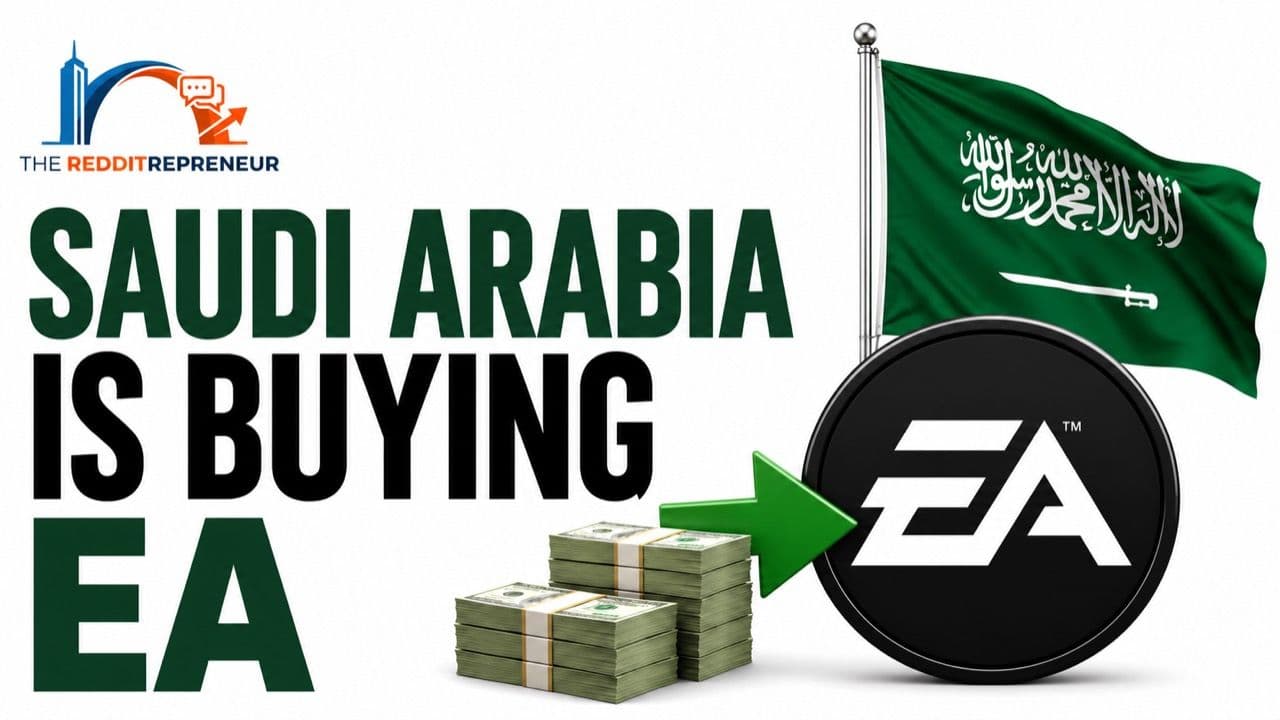
Electronic Arts has agreed to a proposed acquisition by an investor group led by Saudi Arabia's Public Investment Fund.
The group also includes Silver Lake and Affinity Partners.
The deal has received European Union merger approval, but it has not been confirmed as legally completed.
If the remaining conditions are met and the deal closes, the investor group may be able to buy EA.
But buying the company does not automatically mean buying the trust of the people who play its games.
EA owns some of the biggest names in gaming.
Its portfolio includes games connected to football, American football, Formula 1, The Sims, Battlefield and several other large gaming communities.
These games are not valuable only because of their sales.
They are valuable because millions of people care about them.
Players spend years building teams, learning maps, creating characters, joining online groups, watching creators and arguing about every update.
That community loyalty is one of EA's most important assets.
It is also the hardest asset for a new owner to control.
A Company Can Be Bought. A Community Cannot.
When one company buys another, most business coverage focuses on the money.
People ask how much the deal is worth, whether regulators will approve it and what it means for shareholders.
Gaming communities usually ask different questions.
- Will the games change?
- Will prices increase?
- Will more features be locked behind payments?
- Will certain stories, characters or creative choices disappear?
- Will the new owners understand what players care about?
These questions matter because players do not experience EA as one large corporation.
They experience individual games.
A football fan may care deeply about EA Sports FC but have no interest in The Sims.
A Battlefield player may judge EA based on game updates, server quality and communication from developers.
Each EA franchise has its own history, expectations and community culture.
A new owner would not simply inherit one audience.
It would inherit many different communities.
Ownership Does Not Create Legitimacy
There is a difference between having the legal right to control something and being accepted by the people who care about it.
If the proposed acquisition closes, the PIF-led investor group would control EA.
It would gain control over the company's leadership, budgets and long-term direction.
But gaming communities would still decide whether that ownership felt acceptable.
This is the Ownership Legitimacy Gap.
The Ownership Legitimacy Gap appears when a company has the legal power to make decisions but has not yet earned the emotional support of the community affected by those decisions.
The larger the gap becomes, the more likely people are to question every update, announcement and business decision.
A normal price increase may be seen as greed.
A delayed game may be seen as poor management.
A change to a character may be seen as political interference.
Once trust is weak, even ordinary decisions can create suspicion.
Players Will Look for Signs That EA Is Changing
Most people will not read company documents or investor presentations.
They will look for simple signals inside the games and studios they know.
They may pay attention to:
- Changes to characters, stories or representation
- New limits on what developers can create
- More aggressive in-game purchases
- Changes to regional content
- Staff departures
- Studio closures
- Public comments from executives
- Delays, cancellations or changes to major franchises
One decision may not create a crisis.
But several decisions pointing in the same direction can create a powerful story.
Players may start saying that EA is no longer the same company.
That belief could spread even before there is clear proof.
This is why community conversations matter.
They show how people are joining separate events together and deciding what those events mean.
EA's Value Comes From More Than Intellectual Property
EA owns brands, technology, studios and game franchises.
But a large part of its value also sits inside its communities.
A franchise like The Sims is valuable because people do more than purchase the game.
They create houses, characters, modifications, videos, jokes, guides and online discussions.
Football games are valuable because fans debate ratings, build teams, follow promotions and play throughout the year.
Battlefield is valuable because players care about maps, weapons, teamwork and the identity of the series.
This can be called Community-Backed Asset Value.
Community-Backed Asset Value is the extra value a product gains because people continue to talk about it, create around it and build part of their identity around it.
A buyer can purchase the franchise.
It cannot force people to keep caring.
If the community loses interest or trust, the financial value of the franchise can fall with it.
The Biggest Risk May Be Uncertainty
Communities do not always react badly because they know something terrible will happen.
Sometimes they react badly because they do not know what will happen.
Unclear ownership creates space for rumours.
Players begin filling in the gaps themselves.
One group may believe nothing will change.
Another may expect censorship.
Another may expect more in-game purchases.
Another may believe the proposed acquisition is mainly about influence rather than gaming.
When the company does not provide clear answers, the loudest explanation can become the accepted explanation.
This is Ownership Opacity.
Ownership Opacity happens when people do not understand why a company may be bought, who will influence decisions or what the new owner plans to change.
The less information people receive, the more they rely on speculation.
EA and the proposed owners would therefore need to communicate more than the financial details of the deal.
They would need to explain what the ownership means for players.
Different EA Communities May React Differently
There will not be one single reaction.
Some players may not care who owns EA as long as the games remain enjoyable.
Some may welcome the possibility of greater investment.
Some may hope that more money leads to better games, improved servers and fewer rushed releases.
Others may be concerned about creative freedom, human rights, political influence or the future direction of certain franchises.
This is why a simple positive or negative score is not enough.
A useful Community Intelligence study would separate reactions into groups.
The Practical Players
These players mainly care about game quality, pricing, servers and updates.
The Cautious Players
These players are waiting to see whether the ownership leads to noticeable changes.
The Optimistic Players
These players believe new investment could improve EA's games and studios.
The Values-Concerned Players
These players are worried about what the ownership represents and whether it will affect EA's creative decisions.
The Disengaged Players
These players may already distrust EA and see the proposed acquisition as another reason to stop paying attention.
Each group needs a different response.
A general public relations statement would not answer all of their concerns.
Cultural Power Is Part of the Deal
Owning a major gaming company is not only a financial investment.
Games influence culture.
They shape how people see sport, competition, identity, storytelling and other parts of the world.
EA's games reach millions of people in homes, schools, online communities and social media feeds.
This creates Cultural Distribution Power.
Cultural Distribution Power is the ability to influence what people see, discuss and experience through entertainment.
A country investing in gaming is therefore gaining more than possible revenue.
It is gaining a larger role in global culture.
That does not automatically mean the games will become political.
But communities are likely to question the reasons behind the investment.
They will want to know whether EA will remain creatively independent.
What EA Should Do Next
EA should not treat community reaction as a small communications problem.
It should treat it as a business risk.
The company should begin by listening carefully across its different gaming communities.
This includes Reddit, YouTube, TikTok, Discord, gaming forums, creator communities and social media.
EA should identify:
- The questions players are asking most often
- Which communities are most worried
- Which rumours are spreading
- Which franchises carry the greatest trust risk
- What proof players need before they feel reassured
- Which decisions could create a major backlash
The company should then provide clear answers wherever possible.
It should explain what will remain unchanged.
It should be honest about areas that may change.
It should protect the independence of developers and make those protections visible.
Most importantly, it should avoid assuming that silence will make the concern disappear.
Silence usually gives the community more space to create its own explanation.
Community Trust Will Decide Whether the Deal Succeeds
An acquisition can be completed with money, lawyers and regulatory approval.
Community acceptance works differently.
It has to be earned over time.
Players will judge any new ownership through the quality of the games, the behaviour of executives, the freedom given to studios and the way the company responds when concerns appear.
The PIF-led investor group may be able to buy EA.
But it cannot simply buy the loyalty surrounding EA's games.
That loyalty belongs to the players.
If new ownership fails to understand that, the most valuable part of the company may become the easiest part to lose.
The Community Intelligence Lesson
Traditional market research can tell EA how many people recognise its games or intend to purchase them.
Community Intelligence can show what players already believe, what they are worried about and how those beliefs are changing.
For a deal of this size, that intelligence should not be collected after a backlash begins.
It should act as an early warning system.
The companies that understand community reaction early have more time to protect trust.
The companies that ignore it often discover the problem after the story has already spread.
Sources
- Electronic Arts, official announcement of the proposed acquisition.
- Public Investment Fund, announcement naming the investor group.
- European Commission, merger case M.12213.
- Reuters via Euronext, EU merger approval and the deal's current status.
Understand What Your Community Is Saying
The Redditrepreneur helps brands understand what online communities believe about them, their competitors and the decisions they make.
A Community Intelligence Audit turns real conversations into clear findings, risks and business recommendations.