

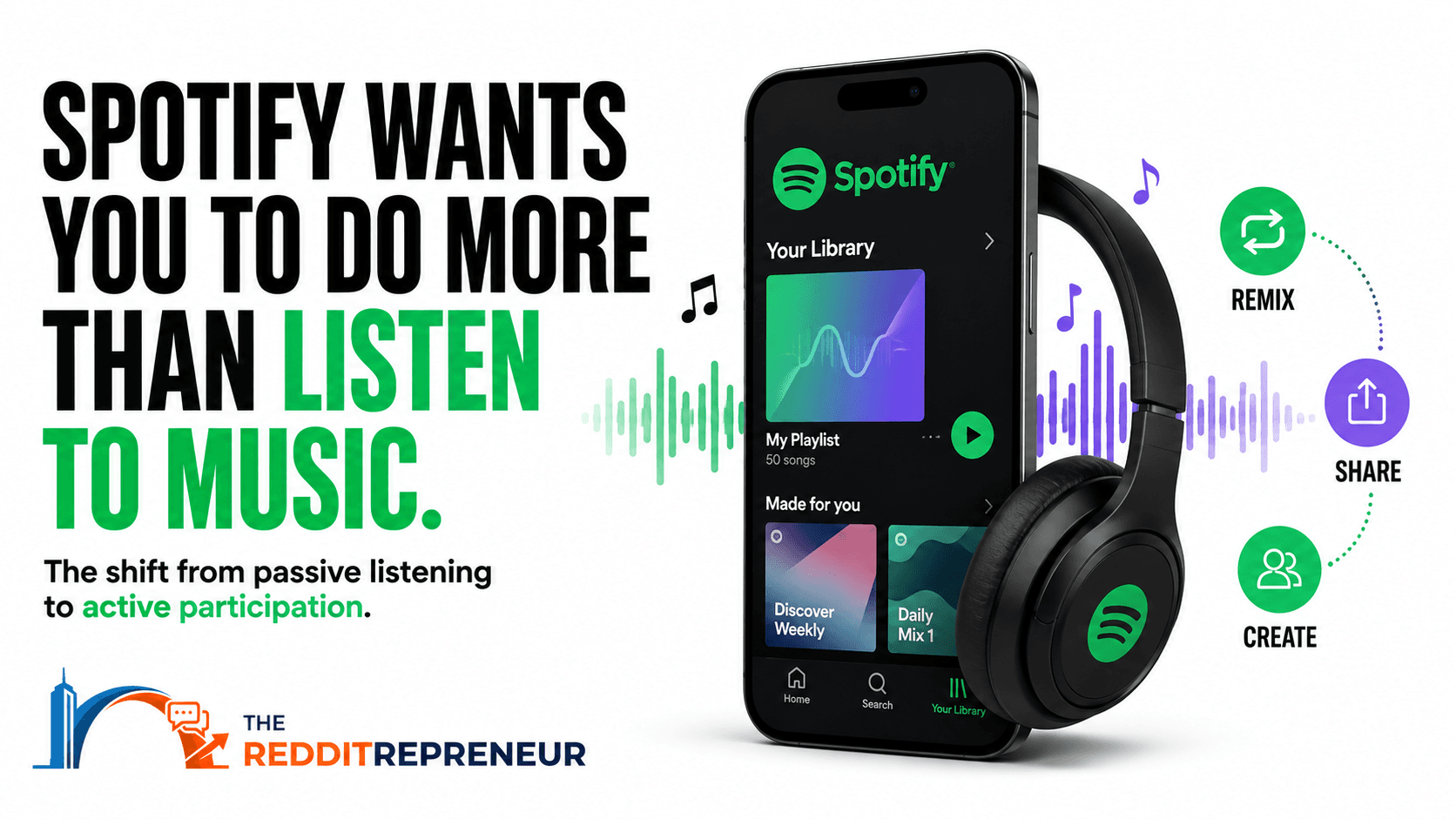
Spotify has spent most of its existence making one thing incredibly easy: press play and listen.
You open Spotify, search for an artist or playlist, and the platform delivers music instantly. Its recommendation system then tries to keep finding more songs you will like.
That basic model has been enormously successful. Spotify has now passed 300 million Premium subscribers and had 777 million monthly active users in its latest quarter. Revenue rose 14% year on year to €4.78 billion.
But Spotify is beginning to push toward something different.
The company is investing more heavily in AI features and recently reached a licensing deal with independent-label group Merlin that supports fan-made covers and remixes. It has also introduced more conversational AI tools that let users interact with Spotify rather than simply choose from a list of songs. Around a quarter of Spotify users are already engaging with its AI features, according to Reuters.
The bigger question is therefore:
What happens when Spotify stops being somewhere you only listen to music and starts becoming somewhere you can interact with music?
That could be a much bigger change than another recommendation algorithm.
Spotify's original product was access
Before streaming, listening to music usually meant owning or downloading something.
You bought:
CDs.
Vinyl.
MP3s.
Then Spotify changed the behaviour.
Instead of owning 500 songs, you could effectively access millions.
The value proposition became:
Anything you want to hear, whenever you want to hear it.
But once every major music service can provide almost the same catalogue, access becomes less differentiated.
Apple Music has huge music libraries.
YouTube Music does too.
Amazon Music does too.
The songs themselves are increasingly available everywhere.
Spotify therefore needs new reasons for listeners to remain inside Spotify specifically.
That is where participation becomes interesting.
The Community Intelligence insight: The Participation Shift
I would describe this as The Participation Shift.
It happens when a digital platform evolves from helping people consume something into giving them ways to participate in it.
The traditional Spotify relationship is:
Artist creates → Spotify distributes → Listener consumes
A more interactive model could become:
Artist creates → Listener discovers → Listener remixes, responds, shares, changes or builds around it
The listener becomes slightly less like an audience member and slightly more like a participant.
That matters because participation usually creates a much deeper relationship than consumption.
Someone can listen to a song once and forget it.
Someone who:
Makes a remix.
Creates a playlist around it.
Shares it with friends.
Discusses it.
Builds something from it.
has invested more of themselves into the music.
That investment can strengthen attachment to both the song and the platform.
This is why the remix deal matters
Spotify's deal with Merlin is easy to dismiss as another licensing agreement.
But the strategic direction is more interesting.
Spotify is creating legal infrastructure around the idea that fans may increasingly want to do something with the music they love, rather than simply play it.
Imagine hearing a song and being able to:
Change the tempo.
Create a shorter version.
Build a transition into another song.
Experiment with vocals and instrumentals.
Create a personalised version for your playlist.
Share your version with friends.
That starts to move Spotify closer to behaviours already visible on TikTok, YouTube and music-production apps.
Music becomes less like a finished object and more like creative material.
TikTok already proved that people want to participate in music
This behaviour is not theoretical.
TikTok helped demonstrate that people frequently connect with music through creation.
A song becomes:
A dance.
A meme.
A video format.
A remix.
A trend.
A soundtrack to another piece of content.
The listener does not merely receive the music.
They use it.
That creates enormous distribution for artists because every fan-created video becomes another potential entry point into the song.
Spotify has historically sat slightly downstream from this behaviour.
TikTok creates cultural participation.
Spotify captures listening.
If Spotify can move participation inside its own product, it could retain more of the cultural activity surrounding music.
This creates the Community Participation Flywheel
The potential loop becomes:
Listen → Create → Share → Discover → Listen
Someone hears a track.
They create something with it.
Other people discover that creation.
They listen to the original.
Some of them create their own version.
The song produces more community activity.
That is much more powerful than:
Listen → Next song.
It turns the community itself into part of the distribution system.
AI makes this possible for ordinary listeners
Traditionally remixing music required some skill.
You might need:
DJ software.
Production software.
Understanding of tempo.
Audio editing knowledge.
Music files.
AI can remove a lot of that difficulty.
Instead of knowing how to use Ableton or Logic, someone could eventually say:
“Make this version slightly faster and give me a smoother transition into the next song.”
The technology handles the complicated part.
That dramatically expands the number of people capable of participating.
This is a wider AI pattern worth watching.
AI does not only automate professionals.
It can give ordinary consumers access to activities that previously required professional skills.
The music version is:
Creation without production expertise.
But there is an important tension for artists
What sounds exciting to listeners can become uncomfortable for musicians.
Artists care deeply about:
Creative control.
Copyright.
Attribution.
How their work is changed.
Whether remixes generate income.
Whether AI generated versions compete with original music.
Whether fans understand what is official.
Spotify therefore cannot simply open every track to unlimited manipulation.
That is why licensing matters.
The platform needs a system where participation creates value without destroying the artist's control over the work.
You could describe this as the Participation Permission Problem.
Fans increasingly want to interact with culture.
Rights holders increasingly need to decide how much interaction they are comfortable permitting.
The companies that solve that boundary well could unlock enormous new creator ecosystems.
Spotify also has another problem: users already feel the app is becoming crowded
This is where Community Intelligence becomes especially useful.
Spotify keeps adding:
Podcasts.
Audiobooks.
Video.
AI.
DJ features.
Social tools.
Ticketing.
More recommendation systems.
Some users love that expansion.
Others increasingly describe Spotify as bloated or say they simply want the music experience to remain straightforward. Current discussions in r/truespotify show exactly that split, with some users praising Spotify's richer music discovery while others complain about too many extra features.
That creates another framework:
The Feature Expansion Tension
Adding more value does not automatically make a product feel more valuable.
A user who wants:
“Play my music.”
may not see:
AI tools.
Audiobooks.
Video.
Remixing.
as improvements.
They may see clutter.
This is similar to the Samsung article in one important respect.
Spotify can technically make the product more capable while some customers feel that the core experience is becoming less focused.
That is why community reaction matters.
The crucial question is not whether Spotify adds AI
It is:
What job do listeners actually want AI to perform?
AI that helps someone discover a perfect song might feel useful.
AI that floods the platform with synthetic music may feel harmful.
AI that lets someone remix a favourite track could feel creative.
AI that replaces the artist could feel exploitative.
Same technology.
Completely different community interpretation.
There is already strong concern around AI-generated music across music communities. A recent academic study examining AI music on streaming services found that most AI tracks receive very few plays, while also warning that cheap mass generation could still create a growing spam problem for platforms.
So Spotify's opportunity is not simply:
More AI.
It is:
AI that increases people's connection with real music rather than increasing the amount of disposable music on the platform.
That distinction matters enormously.
This is where Spotify could create a genuine moat
Spotify's catalogue is not unique.
Its potential community behaviour could be.
If Spotify eventually becomes the place where people:
Listen.
Discover.
Remix.
Share.
Discuss.
Follow artists.
Attend events.
Build playlists.
Express musical identity.
then leaving Spotify becomes harder.
Not because another service lacks the song.
But because another service lacks your relationship with music.
That is a much stronger form of retention.
The moat changes from:
We have the music.
to:
This is where your music life happens.
The Community Intelligence takeaway
The interesting Spotify story is not really about another AI feature.
It is about the evolution of digital media.
The first stage of streaming gave people unlimited access.
The next stage may give them unlimited participation.
Spotify's opportunity is to turn millions of listeners from passive endpoints into people who actively create value around the music they love.
But the company has to be careful.
More features do not automatically create a better experience.
More AI does not automatically create more value.
And giving communities more creative power only works if artists still believe the platform respects the original work.
The bigger lesson for founders is:
When everybody can offer access to the same underlying product, the next competitive advantage may come from what customers are allowed to do around it.
Spotify already won the battle to make music easy to listen to.
Its next battle may be making music more interesting to participate in.
Turn conversations into clarity
Explore the Community Intelligence platform or commission a focused audit of your brand, competitors and market.