

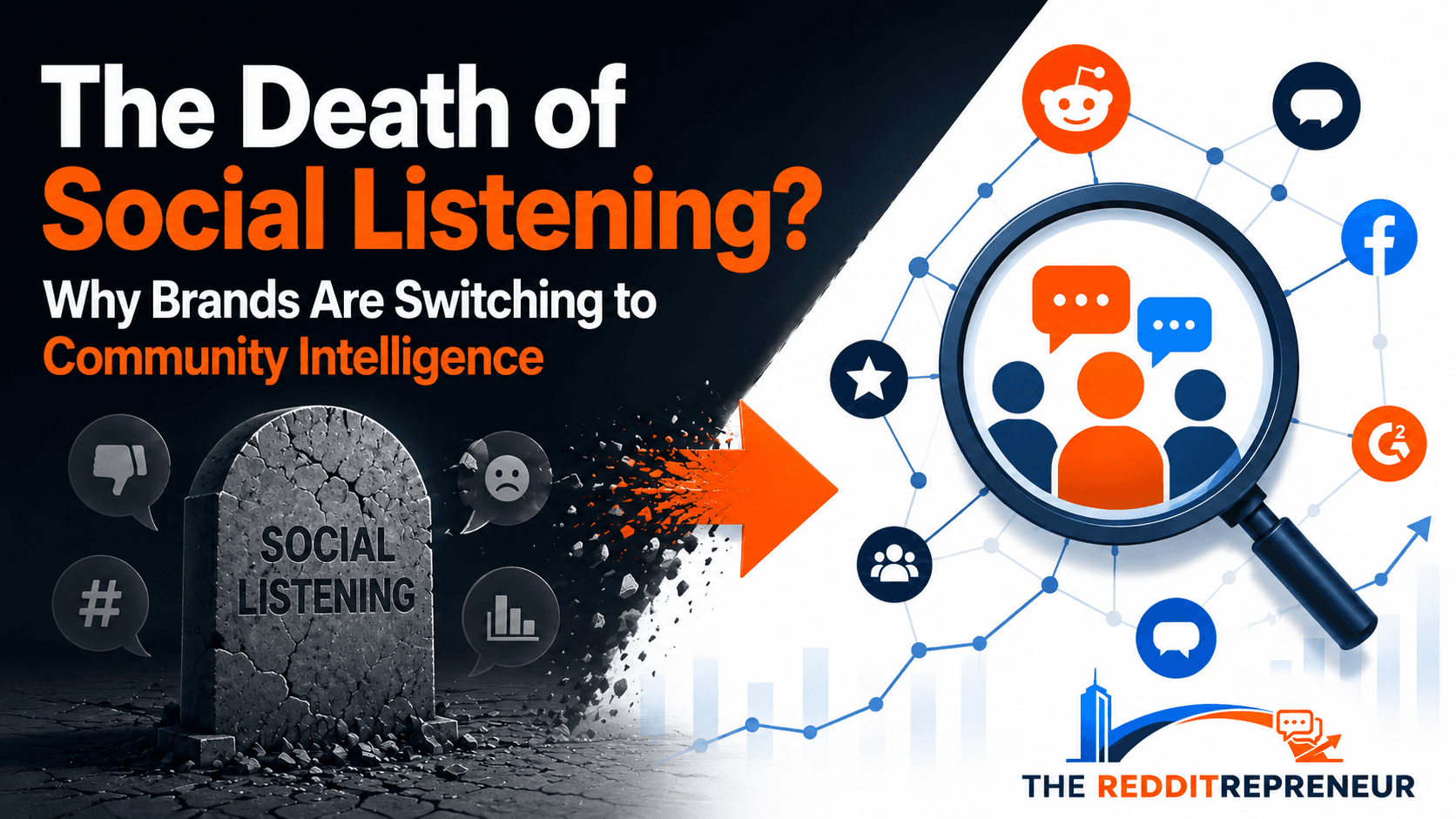
For the past decade, enterprise marketing teams have relied on a comfortable fiction: Social Listening.
We bought expensive software, tracked arbitrary keyword spikes on broadcast networks, and presented slick pie charts mapping "positive vs. negative sentiment" to the C suite. We convinced ourselves that tracking how many times our brand name was mentioned on X (formerly Twitter) or Instagram meant we understood our market.
It didn't. It just meant we were counting noise.
Today, consumers don’t talk to brands on public broadcast networks, they talk to each other in high context, decentralised forums, subreddits, and niche communities.
Traditional social listening tools are completely blind to these spaces.
If your brand wants to survive the shift toward AI driven search engines (like ChatGPT, Gemini, and Perplexity) that crawl the web for human consensus, you must graduate from tracking noise to capturing truth. You need Community Intelligence.
Unlike legacy social listening, where the metrics are mainly surface level, Community Intelligence finds the cultural context and collective consensus of a community to drive product and service development, targeted marketing campaigns, and executive growth strategies.
The Structural Shift: Social Listening vs. Community Intelligence
To understand why traditional tools fail, look at how they compare under the hood:
| Dimension | Legacy Social Listening | Community Intelligence (The Redditrepreneur) |
|---|---|---|
| Primary Data Source | Surface level keyword matches on broadcast networks (X, Instagram, Facebook). | High context, text dense forums (Reddit, Discord, Niche Subcommunities). |
| Core Metric Tracked | Raw Mention Volume, Impressions, and Share of Voice (SoV). | Semantic Intent Analysis, Contextual Sentiment, and Share of Consensus (SoC). |
| Data Authenticity | High bias. Dominated by influencer culture, PR broadcasts, and algorithmic outrage. | High integrity. Unprompted, anonymous peer to peer recommendations and authentic problem solving. |
| Algorithmic Impact | Surface level brand tracking and basic crisis alert management. | Direct optimization of the training and RAG scraping layers for AI search models. |
| Strategic Output | Automated positive/negative pie charts and generic keyword alert clouds. | Actionable intelligence reports covering product gaps, buyer bottlenecks, and GEO vulnerabilities. |
Three Reasons Legacy Social Listening Fails Modern Brands
1. It Completely Misses the "Intent Layer"
Legacy social listening counts a post complaining about a flight delay the exact same way it counts a 2,000 word Reddit thread breaking down the mechanical architecture of a B2B SaaS platform.
Community Intelligence focuses on Information Gain. It isolates high intent discussions where users are actively asking peers for software recommendations, detailing specific technical workflows, or expressing unprompted frustrations with current market solutions.
2. It Suffers from "The Broadcast Bias"
The data scraped by old school listening tools is performative. People post on broadcast networks to build a public personal brand or demand customer service from an airline.
People post in niche communities to find answers. When someone goes to a specialized subreddit to ask,
"What is the actual bottleneck when scaling this database architecture?"
they are seeking truth. Community Intelligence listens to the spaces where people have dropped their guard.
3. It Leaves You Blind to AI Search (GEO & AEO)
This is the most critical threat to modern marketing. AI search engines like ChatGPT, Gemini, and Perplexity do not query legacy social listening dashboards to answer a user’s prompt. They use Retrieval Augmented Generation (RAG) to scrape long form, high consensus human forums like Reddit.
If your legacy tool tells you your brand sentiment is "90% positive" based on your own corporate posts, but a viral thread in a core community labels your software as unstable, AI engines will actively recommend your competitors. You have an AI Search Blindspot.
How to Operationalize Community Intelligence
Transitioning your enterprise from reactive social listening to proactive Community Intelligence requires a three step playbook:
- Map Your Category Consensus: Stop tracking your brand name exclusively. Track the problems your category solves. Find the exact phrases, complaints, and workarounds your target buyers are discussing without you in the room.
- Audit Your AI Search Footprint: Query generative engines to see if your brand is being cited in product recommendations. If you are missing from the conversation, trace back the community data pipelines feeding those models.
- Deploy Automated Community Intelligence Reports: Scale your operation using software built specifically for forum architecture.
Stop Flying Blind
The internet has changed. The days of shouting at an audience from a corporate social media handle and tracking the echo are over. The modern buyer relies on community consensus, and the modern search engine rewards it.
Want to see how your own brand scales against these insights? Drop your company name and details into The Redditrepreneur SaaS to reveal your real world community footprint.
Turn conversations into clarity
Explore the Community Intelligence platform or commission a focused audit of your brand, competitors and market.