

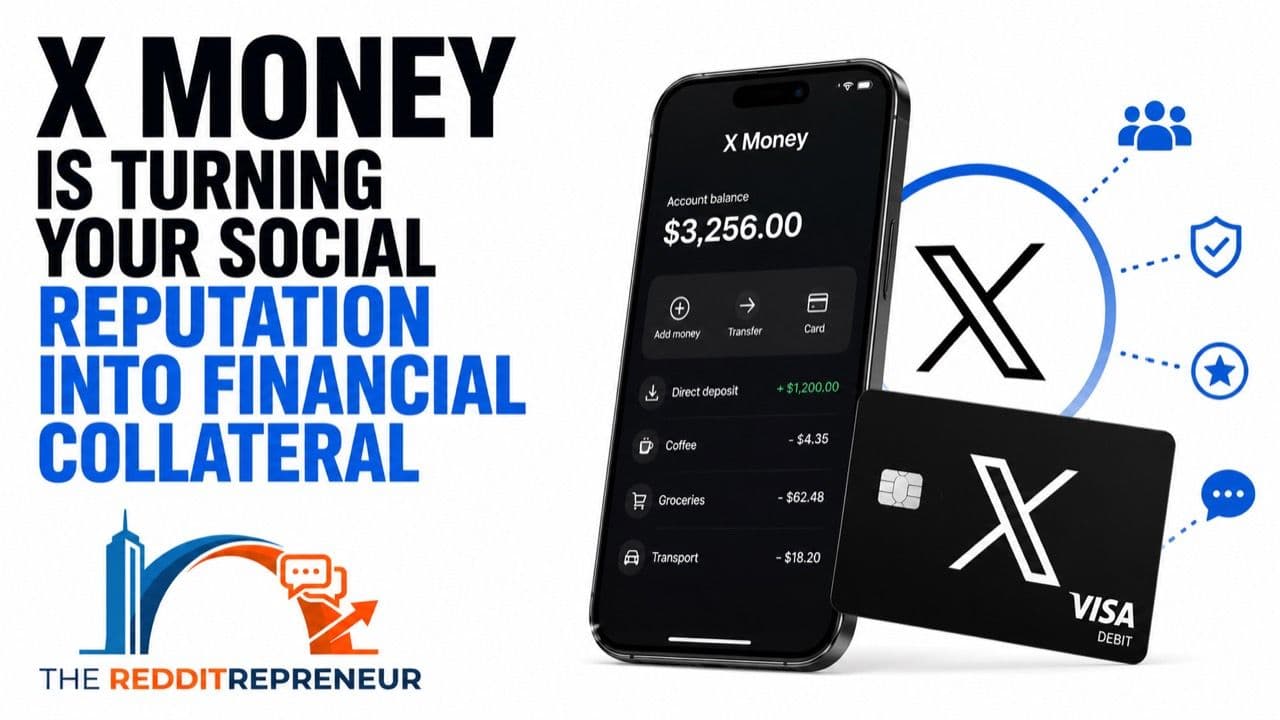
X has moved further into financial services.
X Money launched in the United States on an invite-only basis for paying X members.
It offers a bank account-like service, payments between X users and an X-branded Visa debit card.
X Money is not a new bank. Cross River Bank provides the banking services behind it.
This is still an early and limited launch. X has not made the service available to every user or every country.
Most reporting will compare X Money with services such as PayPal, Cash App and Venmo.
But X Money is different in one important way.
It starts with a public identity.
People on X already have:
- A username
- A profile
- Followers
- A posting history
- Public opinions
- Community relationships
- A reputation
X Money connects that identity with financial activity.
This could change how people decide who looks trustworthy enough to receive money.
A Social Account Can Become a Financial Identity
Payment apps normally identify people through a name, phone number, email address or account number.
X Money adds another layer.
The person receiving money may also have a visible public profile.
Before sending money, someone could check:
- How long the account has existed
- Whether the account appears genuine
- Who follows it
- Whether trusted people interact with it
- What the person has posted
- Whether they are respected inside a community
- Whether other users have warned people about them
These social signals are not the same as an official identity check or a check of someone's financial history.
But they can still influence whether a person feels safe sending money.
Introducing Social Trust Collateral
Social Trust Collateral is the financial credibility a person appears to gain from their online reputation.
This can come from:
- A long account history
- Trusted followers
- Community support
- Public expertise
- Positive interactions
- Recommendations from other users
It does not prove that someone is financially reliable.
It simply makes them appear more trustworthy.
That appearance can affect financial decisions.
A creator with a loyal following may find it easier to receive payments.
A recognised expert may appear safer than an unknown account.
A person supported by trusted community members may receive money more easily.
The community becomes part of the payment decision.
The Path From Attention to Payment Becomes Shorter
Before native payments, someone might:
- Publish a post
- Build attention
- Ask followers to visit another website
- Send them to a separate payment service
- Complete the transaction elsewhere
X Money could shorten that process.
The new path could be:
Post → Attention → Community trust → Payment request → Money sent
This is the Reputation-to-Transaction Pipeline.
It turns public influence into financial action with fewer steps.
This Could Be Useful for Creators
Creators already use online communities to build audiences.
They then move those audiences to:
- Membership platforms
- Online shops
- Donation pages
- Payment links
- Affiliate websites
Native payments could let creators receive money without asking followers to leave X.
That may make direct support and payments easier.
Future uses could include more creator services, but X has not confirmed that every possible payment feature is available now.
Closer integration could also make creators more dependent on one platform.
If the same account controls audience access, public reputation, creator income and payments, losing access to that account becomes much more serious.
That platform risk is also explored in our article about Patreon and borrowed independence.
Social Trust Can Also Be Manipulated
Online reputation is not always reliable.
Accounts can be:
- Hacked
- Copied
- Impersonated
- Bought
- Filled with fake followers
- Given misleading signs of authority
- Used to run scams
A fake account may copy the name, photo and posting style of a trusted creator.
It could then ask followers to send money.
The same community signals that make payments feel safer could also make a scam more convincing.
This creates a larger Community Fraud Surface.
It means X Money will need strong systems for identity checks, account recovery, fraud reporting, payment disputes, impersonation and customer support.
Verification Becomes More Important
A verification badge can affect how people judge an account.
With payments, that judgement could influence whether someone sends money.
That gives verification a financial consequence.
Mistakes become more serious.
A false account that looks verified may appear financially trustworthy.
A real person who loses verification may struggle to prove that they are genuine.
A hacked account could use years of community trust to request money from followers.
Financial trust cannot depend only on social signals.
But users may still treat those signals as proof.
What Happens When an Account Is Suspended?
X has published rules about what happens to X Money when a social account is suspended.
Its help page says most suspended users can continue using Money features.
It also says people suspended under two named safety policies lose Money access and receive remaining funds by cheque.
This shows that social account decisions and financial access can be connected in some cases.
This is called Moderation-to-Money Risk.
It is the risk that a decision about someone's social account affects their financial activity.
Users will need clear answers about:
- Account suspension
- Account recovery
- Handle changes
- Deleted profiles
- Fraud investigations
- Payment access
- Financial complaints
X Must Transfer Platform Trust Into Financial Trust
Using a social platform does not automatically mean someone trusts it with money.
Posting a message carries one level of risk.
Holding money or receiving business payments carries a much higher level of risk.
Users will need to trust several organisations at once.
These include X, Cross River Bank, Visa, the payment systems, the fraud team and customer support.
One poor experience could damage trust in the whole product.
A payment service must work when things go wrong, not only when everything works normally.
Communities May Decide Whether X Money Feels Safe
People will not judge X Money only through adverts.
They will also search community posts, videos, reviews, news reports, AI assistants and scam warnings.
They will look for real experiences.
They will ask:
- Did someone lose access to their money?
- Were fraudulent payments refunded?
- Was customer support helpful?
- Did a suspended account affect financial access?
- How are deposits protected?
- Are rates and rewards easy to understand?
- Can businesses rely on the service?
- Can creators trust it with their income?
These community conversations will shape whether X Money feels legitimate.
They can also become part of the evidence used by search engines and AI systems when people ask whether a service can be trusted.
The Community Intelligence Lesson
The first generation of social media turned attention into advertising revenue.
The next generation may turn community trust directly into financial action.
X Money connects identity, reputation, followers, content and payments.
That creates convenience.
It also creates new risks.
The biggest question is not whether X can add payments to its platform.
The biggest question is whether people trust the platform, its partners and each other enough to use them.
When money becomes part of a social network, communities are no longer only audiences.
They become part of the trust system.
That is why Community Intelligence matters.
Community Intelligence Framework
Social Trust Collateral
The financial credibility a person appears to gain from their visible reputation and relationships inside an online community.
Reputation-to-Transaction Pipeline
The direct path from content and attention to trust and payment.
Community Verification Layer
The way users examine profiles, followers, account history and community support before deciding whether someone is genuine.
Moderation-to-Money Risk
The risk that a social platform decision affects a person's ability to access, send or receive money.
Platform Trust Transfer
The attempt to turn trust in a social platform into trust in its financial services.
Community Fraud Surface
The scams and fraud risks created when financial requests can move quickly through trusted follower networks.
Editor's Note
Financial products are not judged only through features, prices and interest rates.
They are judged through trust.
X Money is unusual because it places money inside a platform where people already build public identities and community reputations.
Community Intelligence can help explain whether users see that connection as useful, risky or both.
Sources
- Associated Press, current X Money launch, availability and banking-partner details.
- X Help, how account suspension affects X Money access.
- X Help, authenticity, impersonation and scam rules.
Understand the Trust Signals Shaping Financial Decisions
Are online communities shaping how people trust your brand, product or financial service?
A Community Intelligence Audit can uncover the conversations, concerns and trust signals influencing customer decisions.