

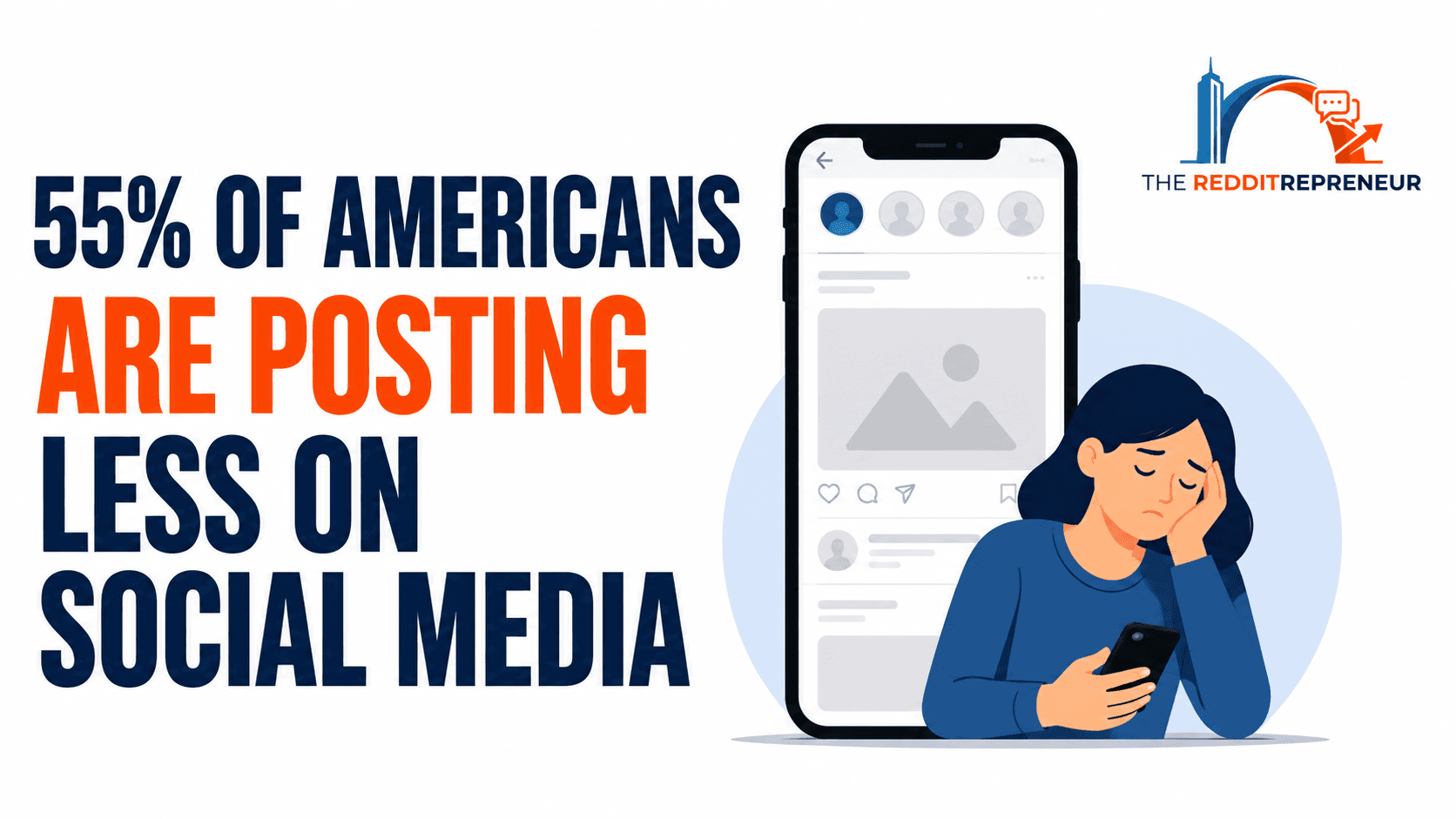
People aren't leaving social media. They're just becoming quieter.
For years, success on social platforms has been measured by how many people log in.
Daily active users.
Monthly active users.
Time spent.
Video views.
Those numbers still look impressive across most major platforms.
But underneath them, something important is changing.
Research published this week suggests 55% of Americans now post less on social media than they did five years ago.
They're still scrolling.
Still watching.
Still consuming.
They're just contributing less.
That might sound like a small behavioural shift.
In reality, it could become one of the biggest challenges facing social platforms, marketers and brands over the next few years.
Social Media Has Become a Performance
Think back to Facebook in the late 2000s.
People uploaded blurry holiday photos.
Shared random thoughts.
Posted about what they had for dinner.
Asked simple questions.
Nobody expected every post to be interesting.
Nobody worried about building a personal brand.
Today, almost every platform rewards performance.
Instagram rewards beautiful content.
TikTok rewards entertaining content.
LinkedIn rewards professional insight.
X rewards fast opinions.
YouTube rewards high production value.
The result is subtle but important.
Posting no longer feels like participating.
It feels like publishing.
For many people, that creates pressure.
Questions begin appearing before they even press "Post."
Will people think this is embarrassing?
Will anyone like it?
Does this fit my personal brand?
Will my boss see it?
Will this come back years later?
Is this worth posting at all?
When every post feels like a public presentation, many people simply decide not to post.
Consumption Isn't the Same as Participation
One of the biggest mistakes businesses make is assuming attention equals engagement.
It doesn't.
Someone can spend two hours on Instagram without creating a single piece of content.
They can watch dozens of TikToks without leaving one comment.
They can read LinkedIn every morning without publishing a post for months.
Platforms still benefit from that attention.
But communities don't grow through passive consumption alone.
Communities grow because people contribute.
Every review.
Every opinion.
Every recommendation.
Every debate.
Every story.
Every joke.
Every disagreement.
Those contributions become the content everyone else returns to consume.
If fewer people are willing to contribute, the long term health of the community begins to change.
The Community Intelligence Insight
This is where Community Intelligence becomes commercially important.
Most businesses monitor visible conversations.
Brand mentions.
Comments.
Reviews.
Hashtags.
Campaign engagement.
But what happens when people stop speaking publicly?
You haven't necessarily lost customer opinions.
You've lost visibility into them.
Many conversations don't disappear.
They simply move.
Into Reddit.
Into Discord servers.
Into WhatsApp groups.
Into Telegram chats.
Into private Facebook Groups.
Into Close Friends stories.
Into niche communities where the audience feels smaller and the social risk feels lower.
That's a completely different research environment.
Brands relying only on public social listening may believe customers have become quieter.
In reality, they've simply become more selective about where they speak honestly.
Introducing The Participation Tax
Community Intelligence needs language to describe these changes.
One concept that helps explain this behaviour is The Participation Tax.
The Participation Tax is the emotional, creative and reputational cost someone believes they must pay before contributing publicly online.
That tax includes things like:
Worrying about how a post will be judged.
Editing something until it sounds more impressive.
Trying to satisfy algorithms.
Thinking about future employers.
Comparing yourself with creators.
Feeling pressure to perform.
Wondering if anyone will engage.
The higher that perceived cost becomes, the less frequently people contribute.
Importantly, they don't necessarily leave the platform.
They simply become observers instead of participants.
Why Reddit Benefits
This helps explain something many marketers have noticed.
Reddit often contains discussions people would never publish on LinkedIn or Instagram.
Not because Reddit users are fundamentally different.
Because the environment is different.
People usually arrive around a shared interest rather than a shared identity.
They are discussing the topic, not presenting themselves.
That lowers the Participation Tax.
People ask questions they might otherwise avoid.
Admit mistakes.
Share frustrations.
Recommend products honestly.
Debate openly.
For Community Intelligence research, those conversations become incredibly valuable.
They reveal beliefs that polished social feeds often hide.
Why Brands Should Care
This isn't just a platform story.
It's a marketing story.
If fewer people post publicly, brands relying entirely on public social media will understand progressively less about their customers.
That makes communities even more important.
The richest customer insight may no longer come from viral posts.
It may come from:
Small Reddit communities.
Private Discord servers.
Product forums.
Customer support conversations.
Creator communities.
Closed Facebook Groups.
Professional Slack communities.
Brands willing to study those spaces responsibly will understand customer behaviour far earlier than those waiting for public trends to appear.
Something To Remember
People haven't stopped having opinions.
They've become more careful about where they share them.
That's a crucial distinction.
The future of Community Intelligence won't belong to whoever measures the loudest conversations.
It will belong to whoever understands the conversations people still feel comfortable having.
Because while public feeds are becoming performances...
Communities are becoming the places where honesty still lives.
Community Intelligence Takeaway
The next generation of customer insight won't come from measuring who is speaking the loudest.
It will come from understanding where people still feel safe enough to speak naturally.
That's exactly why Community Intelligence matters.
It helps brands understand the conversations happening beyond the algorithm, before those conversations become visible everywhere else.
Turn conversations into clarity
Explore the Community Intelligence platform or commission a focused audit of your brand, competitors and market.