

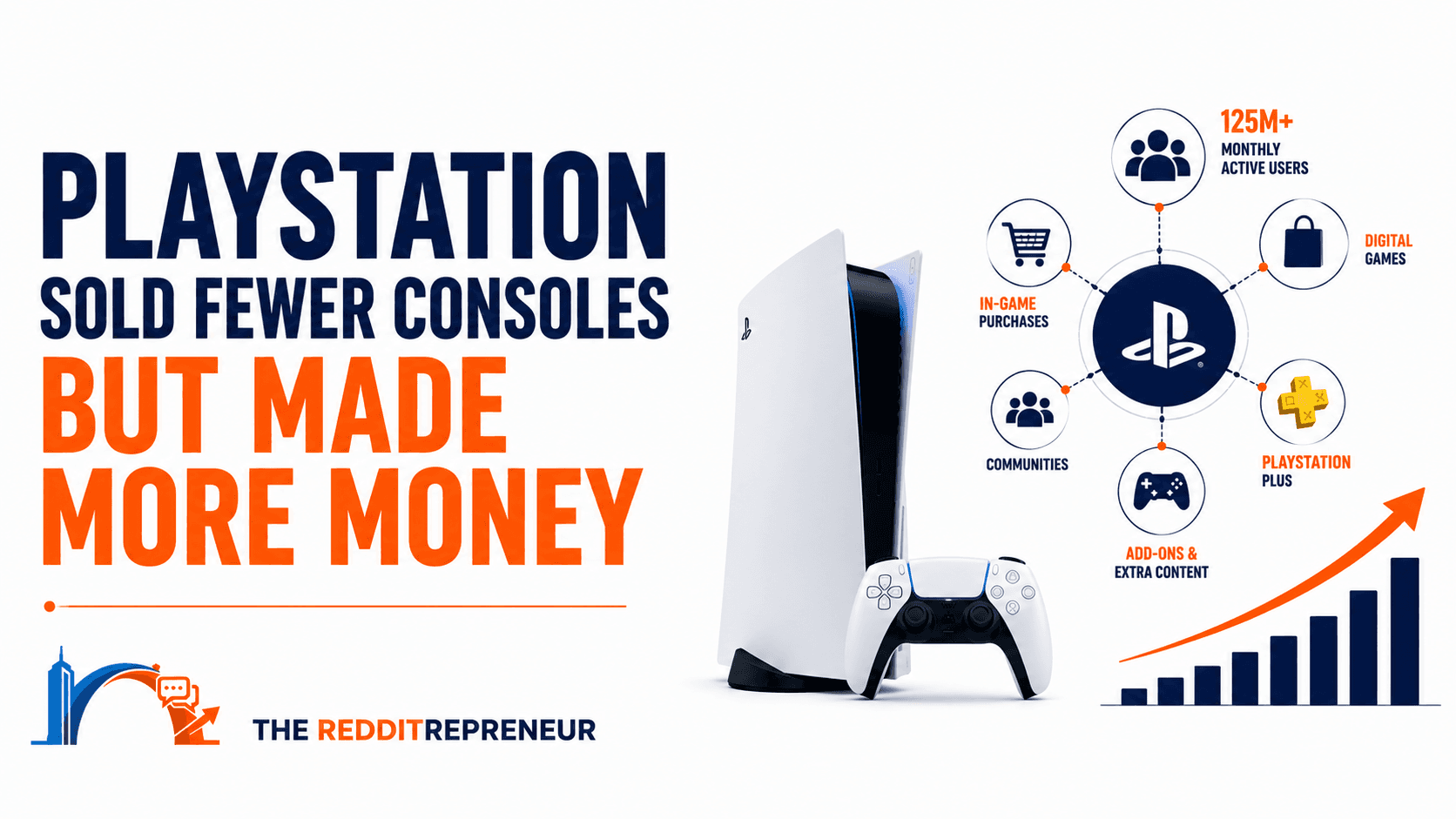
Sony shipped fewer PlayStation 5 consoles than it did in the same quarter a year earlier.
But operating profit in its gaming business increased.
That may sound confusing.
It becomes easier to understand when PlayStation is viewed as more than a console company.
PlayStation can make more money while selling fewer consoles because Sony already has a large community of active users who continue buying games, subscriptions, add-ons and in-game content. The console creates access to the ecosystem, but repeated community participation creates the long term value.
What Sony Has Confirmed
For the quarter ended 30 June 2026, Sony reported 1.6 million PS5 shipments. That was down from 2.5 million in the same quarter a year earlier.
Sony also reported 125 million monthly active PlayStation accounts and higher operating profit for its Game & Network Services business.
These figures describe accounts and business results. They do not prove that every active player is loyal, satisfied or using a PS5.
What Happened
Sony’s latest results show a business moving further into the later years of the PS5 cycle.
Fewer new consoles were shipped than a year earlier.
At the same time, Sony’s gaming profit rose.
The company said game software and network services helped the result.
Network services include products such as PlayStation Plus.
Software includes digital games and extra content sold through the platform.
Sony says cumulative PS5 shipments have reached 95.3 million.
It also reported 125 million monthly active PlayStation accounts in June 2026.
That active-user figure covers PlayStation as a whole. It is not a count of PS5 owners.
A Console Sale Is the Beginning of the Relationship
When someone buys a PS5, Sony receives money from the hardware sale.
But the relationship does not end there.
Over the next several years, that player may:
- Buy digital games
- Pay for PlayStation Plus
- Buy extra content
- Spend money inside games
- Renew subscriptions
- Purchase a future console
- Encourage friends to join
The hardware sale opens the door to a much longer commercial relationship.
This is Post-Purchase Community Economics.
Post Purchase Community Economics
Post-Purchase Community Economics is the value created after the original product has been bought.
For PlayStation, that value may continue for years.
A player might buy one PS5 and then make many smaller purchases through the platform.
Sony does not need to sell that person another console every quarter.
It needs to give them reasons to keep returning.
Installed Community Value
Installed Community Value is the value created by people who already use a product or platform.
PlayStation’s existing community includes console owners, PlayStation Plus members, online players, digital buyers and people waiting for major releases.
These people already have accounts.
Many have games, payment details, friends and years of history inside PlayStation.
That makes them easier to reach than completely new customers.
The Community Is a Distribution System
A platform with millions of active users can introduce new games quickly.
A developer can release a game into an environment where players already have accounts, payment methods, friends, subscriptions and a habit of checking the store.
This is Community Distribution Infrastructure.
Community Distribution Infrastructure
Community Distribution Infrastructure is a large active audience that makes it easier to launch and sell new products.
PlayStation sells its own games and provides distribution for outside publishers.
When a major game launches, Sony may benefit from game sales, store fees, PlayStation Plus use, add-on purchases and greater activity.
The community makes PlayStation useful to publishers.
More games then make the platform useful to players.
One Major Game Can Bring People Back
Some people use their console every day.
Others stop playing for weeks or months.
A major release can bring some of them back.
Grand Theft Auto VI is one possible future example, depending on its release plans and player response.
A returning player could renew PlayStation Plus, reconnect with friends, buy another game or visit the PlayStation Store.
This is Blockbuster Community Reactivation.
Blockbuster Community Reactivation
Blockbuster Community Reactivation happens when a major release brings inactive or less active users back into a wider platform.
The game does more than sell copies.
It may restart activity across the ecosystem.
The outcome is not guaranteed.
Sony Can Benefit From Communities It Does Not Own
Sony does not own every major game on PlayStation.
Games such as Fortnite, Call of Duty, EA Sports FC and Grand Theft Auto have their own communities.
Those communities may bring players into PlayStation and keep them active.
Sony may then benefit from store purchases, subscriptions, in-game spending and platform activity.
This is External Community Value Capture.
External Community Value Capture
External Community Value Capture happens when a platform makes money from a community built around another company’s product.
The Fortnite community belongs mainly to Fortnite.
Its activity can still create value for PlayStation.
That is useful for Sony, but it also creates a risk.
PlayStation May Depend on Outside Communities
If too much activity depends on a small number of outside games, Sony becomes more dependent on companies it does not control.
This is Community Dependency Concentration.
Community Dependency Concentration
Community Dependency Concentration is the risk created when too much participation depends on a few outside products or communities.
If a major publisher changes its strategy, raises prices or moves attention elsewhere, PlayStation may be affected.
Sony therefore needs strong first-party games as well as successful third-party games.
It needs players to care about PlayStation itself, not only the games available on it.
Active Users Are Not Always Loyal Users
A player can log into PlayStation every month without feeling strongly loyal to Sony.
They may remain because their friends, digital games, trophies and saved data are there.
They may also have already paid for PlayStation Plus.
This is Activity-Trust Divergence.
Activity-Trust Divergence
Activity-Trust Divergence is the gap between using a platform and genuinely trusting or supporting it.
A person may remain active while feeling frustrated by prices, worried about digital ownership or ready to move to PC.
Monthly active users show that people returned.
They do not explain why.
Community Intelligence helps explain the reason.
Digital Libraries Create Accumulated Platform Gravity
A player may collect games, trophies, friends and memories over many years.
The more they collect, the harder it can become to leave.
This is Accumulated Platform Gravity.
Accumulated Platform Gravity
Accumulated Platform Gravity is the growing force that keeps people inside a platform as they build history and value there.
A person may have hundreds of digital games, years of saved data, subscriptions and community history.
Leaving PlayStation may mean losing easy access to some of that value.
That can create strong retention.
It does not always create genuine affection.
This extends the wider idea of Community Gravity.
Friends Create a Social Switching Cost
Gaming is social.
A player may prefer another console or PC but stay on PlayStation because their friends are there.
This is Social Switching Cost.
Social Switching Cost
Social Switching Cost is the relationship value a person risks losing when moving to another platform.
The cost may include leaving a regular gaming group, rebuilding a game library, learning a new system or missing shared releases.
For some players, the community matters more than the hardware specifications.
Some Players Identify With Games, Not Consoles
People still describe themselves as PlayStation, Xbox or Nintendo players.
But some users may identify more strongly with Fortnite, Roblox, Minecraft or Call of Duty.
The game community can matter more than the console brand.
This is Platform Identity Dilution.
Platform Identity Dilution
Platform Identity Dilution happens when users feel more connected to individual games than to the platform hosting them.
PlayStation can remain commercially strong while becoming less important to a player’s identity.
Sony therefore needs to give people reasons to care about PlayStation itself.
These may include strong first-party games, a trusted store, fair subscription value, reliable services and clear rules for digital ownership.
Our analysis of Halo coming to PlayStation explores how platform identity changes when games move between communities.
Strong Revenue Does Not Prove Strong Trust
Sony can make more money from the same group of players.
That does not automatically mean the community is healthier.
Players may spend more because games cost more, purchases are increasingly digital or a smaller group is spending heavily.
Sony should also understand player trust, subscription satisfaction, reasons for returning and intent to move elsewhere.
Community Retention Quality
Community Retention Quality is the strength of the reasons people remain inside a platform.
High-quality retention can come from enjoyment, trust, friends, good value and a sense of belonging.
Lower-quality retention may come from lock-in, habit, switching costs or fear of losing purchases.
Both types can produce active users.
Only one supports a healthy long-term relationship.
What PlayStation Must Understand Next
Sony now has a large existing community.
The challenge is not only attracting new console buyers.
It is understanding why current players return, which releases reactivate inactive users and what makes people trust the platform.
It should also study why people cancel PlayStation Plus and whether users identify with PlayStation or only with specific games.
The Community Intelligence Lesson
The PS5 created access to the audience.
But the audience now creates value far beyond the original hardware sale.
Sony can continue earning when players return, play, subscribe, buy digital products and reconnect with friends.
That helps explain how PlayStation profit can rise even when console shipments fall.
But Sony should not assume that activity automatically means loyalty.
The useful question is not only how many people used PlayStation.
It is why they returned, what keeps them there and what could make them leave.
Community Intelligence Frameworks
Installed Community Value
The value created by users who are already active inside a platform.
Post-Purchase Community Economics
Revenue and loyalty created after the original product purchase.
Participation-Led Monetisation
Making money through repeated activity rather than repeated hardware sales.
Community Distribution Infrastructure
A large active audience that makes it easier to launch and sell new products.
Blockbuster Community Reactivation
A major release bringing inactive users back into a wider ecosystem.
External Community Value Capture
A platform benefiting from communities built around another company’s product.
Community Dependency Concentration
The risk of relying too heavily on a few outside franchises or communities.
Activity-Trust Divergence
Users remaining active while trust or satisfaction declines.
Accumulated Platform Gravity
The growing difficulty of leaving as users build libraries, history and relationships.
Social Switching Cost
The friendships and group habits a user risks losing by changing platforms.
Platform Identity Dilution
Users identifying more strongly with individual games than with the platform.
Community Retention Quality
The strength and health of the reasons people remain.
Community Revenue Density
The financial value created by each active community member.
Dormant Community Reactivation
Bringing inactive users back through a major event, game or update.
What This Means
- Sony shipped fewer PS5 consoles than a year earlier, but its gaming operating profit increased.
- Existing players can create years of value after buying a console.
- PlayStation’s active community is a major commercial asset.
- Major games may bring inactive players back into the ecosystem.
- Sony benefits from communities built around games it does not own.
- Active users are not automatically loyal or satisfied users.
- Friends, digital libraries and history may make it harder for players to leave.
- Community Intelligence can explain why people return and what may cause them to leave.
Related Reading
- PlayStation Fans Are Planning a Blackout
- Halo No Longer Belongs Only to Xbox
- GTA VI Is Becoming the Game That Sells the Entire Gaming Ecosystem
Sources
- Sony Group, FY2026 Q1 earnings announcement and related materials.
- Sony Interactive Entertainment, business data and sales.
- Sony Group, Game & Network Services segment meeting materials.
Understand Why Your Community Keeps Returning
Active-user figures tell you how many people came back. Community Intelligence explains why they returned, what keeps them involved and what could make them leave.
Book a Community Intelligence Audit Explore The Redditrepreneur